Path of Exile 1 has kept running its own league schedule throughout the Path of Exile 2 early access period, and that is the first thing a returning player gets wrong: the two games do not share a patch, a league or a character. If the last thing you remember is parking a character in a hideout a few leagues ago, three Path of Exile 1 challenge leagues have shipped since — Keepers of the Flame (3.27), Mirage (3.28) and Curse of the Allflame (3.29) — and a large part of what they added is now permanent base-game content rather than a mechanic that vanished when the league ended. This is the short version of what changed while you were away, and what is worth playing now.
What this covers: the three Path of Exile 1 challenge leagues released since late 2025, the systems they added that stayed in the base game, and the changes to gem sockets, the Atlas and the endgame that affect a character you already own. Why it matters: several of these changes rewrite assumptions older builds were built on — where Breach encounters come from, how the Atlas is structured, and what a socket colour now means. Who should care: returning Path of Exile 1 players, and Path of Exile 2 players deciding whether to come back for a Path of Exile 1 league.
The three leagues you missed
Three challenge leagues separate the Path of Exile 1 you left from the one that is on now. Curse of the Allflame (3.29) launched on July 24, 2026, and the league-tracking sources list it as current; before it came Mirage (3.28), whose official patch notes are dated February 26, 2026 and which SlashSkill dates to a March 6, 2026 launch; and before that came Keepers of the Flame (3.27), which the official launch thread marks as live on October 31, 2025.
| League | Patch | Launched | League mechanic | Kept in the base game |
|---|---|---|---|---|
| Keepers of the Flame | 3.27 | October 31, 2025 | Breach hives and the Genesis Tree | Bloodline Classes, Grafts, Asynchronous Trade |
| Mirage | 3.28 | March 6, 2026 | Djinn, Wishes and the Astral Realm | Atlas rework, Exceptional Support Gems, Reliquarian |
| Curse of the Allflame | 3.29 | July 24, 2026 | Charts, Voyages and Allflame crafting | Gem socket rework, Talisman and Abyss revamps, Mercenaries |
A fourth thing happened alongside them: Path of Exile 2 ran its own league, Return of the Ancients (0.5.0), which SlashSkill dates to a May 29, 2026 launch. It is worth naming only to separate it from Path of Exile 1. The two games run independent league schedules, so a Path of Exile 2 patch tells you nothing about the Path of Exile 1 league you are about to log into.
What 3.27 changed for good
Keepers of the Flame was the Breach league. The Breachlords advanced into Wraeclast, Ailith founded the Order of the Keepers of the Flame, and you worked the Genesis Tree to grow Currency, Uniques, Equipment and Grafts. The Grafts were the strange new item: breach-hands you could fuse directly to your character to wield Breach powers. They are the part of a league most players expect to lose when the league ends, and the ones that survive are usually the quiet system changes, not the headline mechanic.
Two of the additions did not disappear. The first is Bloodline Classes: secondary Ascendancy Classes unlocked per character by defeating specific endgame bosses and allocated with your normal Ascendancy points, so a character can now split its Ascendancy budget between its original class and a Bloodline. The 3.27 patch notes list ten of them, each tied to the boss whose power it grants, and the same patch made a full passive-tree refund a single click for a gold cost while letting you refund Atlas passive points with gold at Kirac.
The second addition is convenience, and it is the one a long break makes most obvious. Asynchronous Trade arrived with Faustus, Merchant’s Tabs and off-line instant purchases, alongside an in-game Trade Market bound to the comma key, and item identification moved onto town NPCs so you no longer burn Scrolls of Wisdom identifying a full inventory. None of that is a build decision, but it changes what logging in feels like.
What 3.28 changed for good
Mirage is the patch that most changes how an endgame player actually plays. Its league mechanic sent you into Afarud-controlled areas to free captured Djinn, where a Maraketh sorceress named Varashta offered a choice of three Wishes before you entered the Astral Realm, an imperfect copy of the surrounding area. The three Djinn Coins it introduced are still worth knowing about: Coin of Knowledge, Coin of Power and Coin of Skill each corrupt a level 20 Skill Gem and imbue it with a random valid Support effect of the matching attribute, and because the coin corrupts the gem in the process, an imbued gem cannot also be Vaal-corrupted.
The permanent changes are the reason to read the patch notes rather than a league summary. Map items are no longer tied to a specific area: rather than a Tier 10 Mesa Map, you now find a Tier 10 Map and choose which unlocked Atlas area to open with it. The Atlas itself starts from the centre, with a Voidstone slot in each corner, and the notes set the Unique Map Atlas passives at one point each up to a maximum of ten, out of roughly twenty Unique Maps. Arcane Astrolabes replaced the old Atlas enhancement slot and manifest a Shaped Region in a quadrant, which shrinks as you complete the maps inside it and amplifies the rest, and clearing a region leads to one of four Memory Vaults tied to the quadrants.
The rest of the patch reshaped the loot and progression systems. Over 40 Exceptional Support Gems arrived as a replacement for Awakened Supports, which are being phased out, and they drop in the endgame rather than being crafted one for one. Tier 17 maps became Nightmare Maps at Tier 16. The Scion gained the Reliquarian Ascendancy, whose notables borrow the powers of existing Unique items and change with each league, which is why they are excluded from Forbidden Flame and Forbidden Flesh outcomes. Several new Holy skill gems landed, including Divine Blast, Holy Hammers, Holy Strike and Shield of Light, and the league boss Saresh entered the game as a necromancer pinnacle encounter.
Mirage also made two core-league moves that a returning player notices immediately. Keepers of the Flame went core: you meet Ailith at the Mud Flats entrance in Act 6, Breach Hives and Unstable Breaches spawn from there onward, and Flesh of Xesht arrives as a new currency that transforms a Breach Unique into its alternate version. Harbinger, meanwhile, was removed as a core league, and Fracturing Orbs and Ancient Orbs moved into the core drop pool in its place.
What 3.29 changed for good
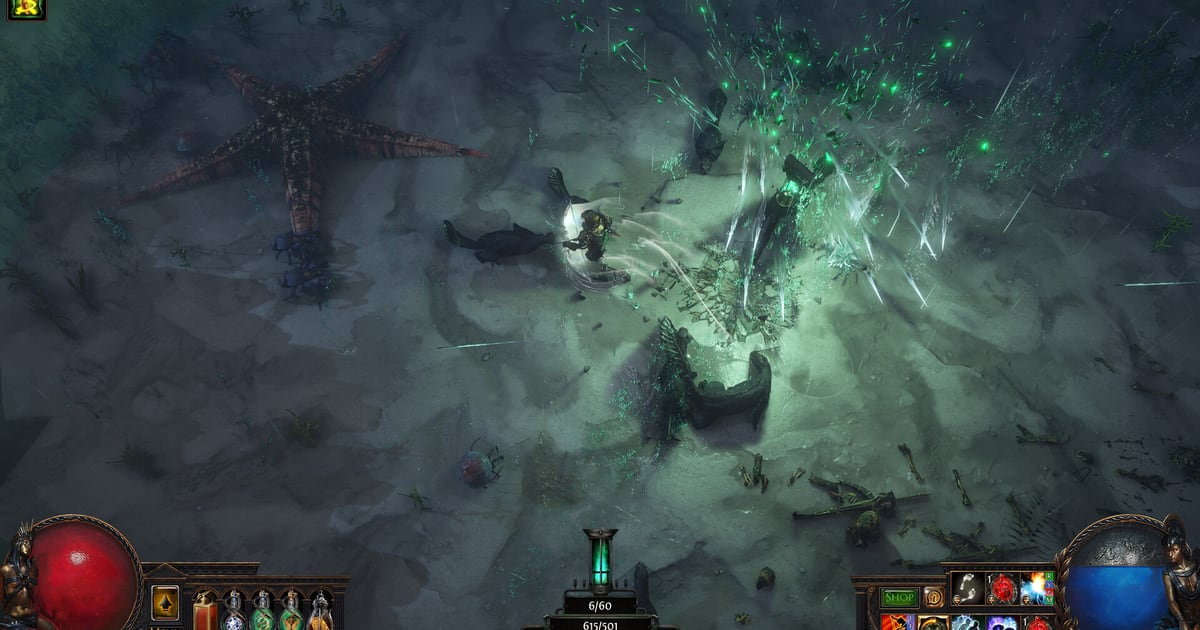
Curse of the Allflame is the current league, and its mechanic is a departure from mapping. You meet Valerie, a corsair captain, and collect Charts scattered across Wraeclast to board The Sovereign and dive to the ocean floor, where Allflame lanterns hold back the water and let you loot while the light lasts. Once you have charted enough areas you connect them into a Voyage, a single large seafloor excursion you can revisit and amplify. The ship also runs Allflame crafting, which feeds it an item and splits it into several spectral outcomes, one of which you keep, and the seafloor yields Ducats that twist items in ways the notes describe as not seen in centuries.
The patch’s permanent changes are the most disruptive to a returning character, because three of them touch systems you already own. Gem sockets changed first: any gem can now be socketed into any equipment socket regardless of colour, and a gem in a socket whose colour matches it gains 10% quality. Sockets are white by default, with a chance to roll red, green or blue weighted by the item’s attribute requirements, and Chromatic Orbs now force one socket to be non-white rather than recolouring the whole set. The practical effect is that a gem no longer needs a matching socket to function at all.
Talismans were reworked to use Enchantment Modifiers rather than Implicit Modifiers and are no longer corrupted by default, with Talismans now dropping from Red Beasts and Bestiary bosses instead of the general drop pool. Abyss was reworked so the pits are open before you arrive and you feed them souls to draw out the monsters beneath, and it became the exclusive source of Abyssal Jewels and Stygian Vises, with a new pinnacle boss attached. Legion gained Crystals of Permutation, which let you enshroud an eligible Unique and transform it into another Unique of the same item class with a Vestigial implicit drawn from the original. Mercenaries of Trarthus went core from Act 3, and the Scion gained the Luminary Ascendancy for permanently hiring them, up to three. Reflect map modifiers were replaced by Thorn modifiers, and Atlas Anomalies were added as map-less endgame areas that ignore your Atlas passive tree.
The post-launch patches are worth knowing about too, because they changed what the league pays out. The 3.29.2 notes rewrote the Chart modifiers that had promised increased gold so they now grant increased item rarity instead, because the gold version was not functioning in Charts and Voyages. The 3.29.3 patch then added the Cursed Ducats that give players a way to add risk for reward, and the 3.29.0b notes raised Chart quantity and rarity modifiers by 20% to 40% while slowing the first stage of lantern collapse by 60%.
What to play now
If you are returning for a single league rather than a long stay, Curse of the Allflame’s league content is the reason to be here, and it plays differently enough from the map loop that it is worth learning from scratch. Its Cursed Ducats are the dial: the 3.29.3 rules let you socket up to three into the Voyage Planner, each adding monster Toughness plus item quantity and rarity, and each carrying its own difficulty modifier, so the system is built around picking the downsides your build can shrug off. You get the first one by defeating Velka and claiming it from Valerie, and keeping at least one socketed is what lets more appear.
For a character rather than a league, 3.29 buffed self-cast spells broadly, which matters if you left behind a caster that felt punished for not being a totem or a mine build. Discharge’s cooldown dropped from two seconds to one, Incinerate went from eight maximum stages to ten, and Winter Orb began firing two to three projectiles at gem levels 1 to 20 instead of one at every level. Minions got a quality-of-life pass in the same patch: non-Spectre minions no longer pause while attacking, which the notes call out as a significant damage-per-second increase for Dominating Blow, Raised Zombies, the Golems, Raging Spirits and Skeletons. Before you commit to a starter, it is worth reading how league-start economies behave in the first-week ARPG economy primer — most of it is written for Path of Exile 2 and Last Epoch, but the pricing logic carries over.
If you are bringing back an old character
A few things are worth checking before you queue into a map. Standard characters keep their existing gear, and items changed by these patches are generally not updated retroactively unless a patch note explicitly says a Divine Orb will apply the new values; the 3.29 notes are careful to label which Unique changes are retroactive and which are not. Your Atlas is now a different shape, and because both trees can be refunded for gold, rebuilding an endgame tree costs currency rather than a fresh character. The socket rules are the other one: an old six-link still functions, but a gem no longer needs a matching socket to work, so what looked like a bricked item may now be usable as-is.
Path of Exile 1 is not a game that asks you to start over, but it is a game that assumes you were reading. Three leagues of core changes have moved enough — sockets, the Atlas, Breach, Mercenaries — that the fastest way back in is to read the last three sets of patch notes before you open a build guide.