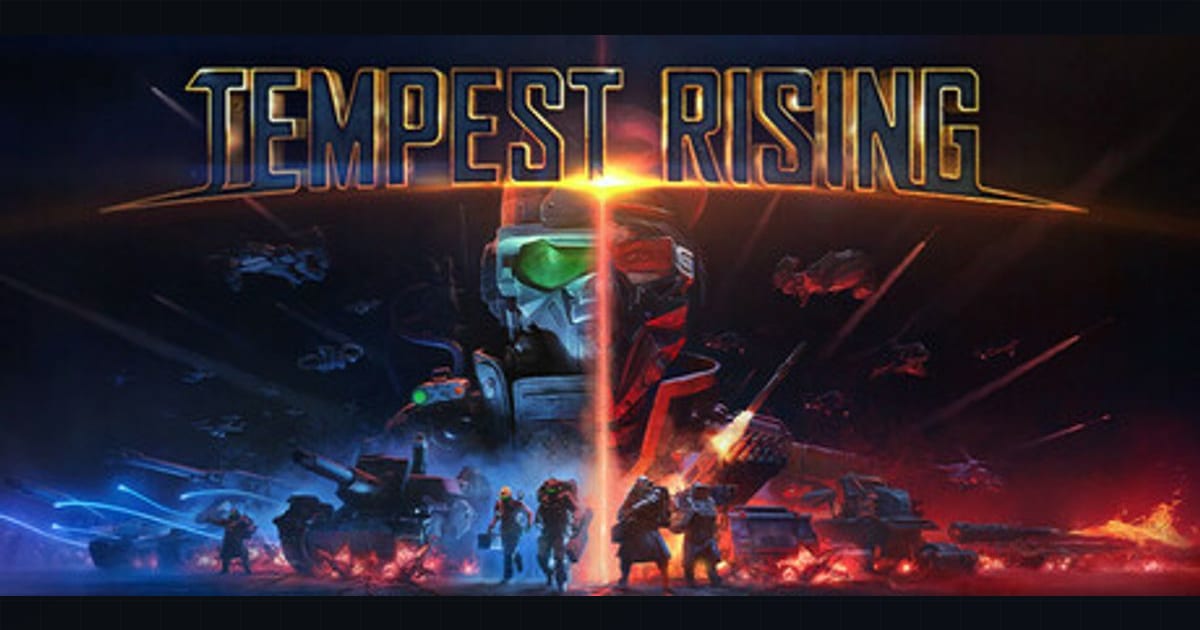
Tempest Rising ships with two factions and no third race on the horizon. That is the most important fact about the game’s competitive shape: you are choosing between the Global Defense Forces (GDF) and the Tempest Dynasty, and the gap between them is wide enough that your factionfaction. An in-game group or nation players can align with or fight against, with its own goals and reputation system. pick dictates your entire ladder experience more than your opening build does. This guide compares the two across the four layers that actually decide RTSRTS. Real-Time Strategy — a strategy game where everyone plays at the same time, continuously, instead of taking turns. games — economy model, unit roster, tech tree shape, and resulting playstyle — so you can pick the side that matches how you already think about RTS.
What it covers: GDF vs Dynasty across economy model, unit roster, tech shape, and resulting playstyle. Why it matters: With only two factions, your pick dictates the ladder experience more than your opening build does. Who should pick this: RTS players choosing a Tempest Rising main.
Two factions at a glance
| Dimension | GDF (Global Defense Forces) | Dynasty (Tempest Dynasty) |
|---|---|---|
| Identity | Conventional military, combined arms | Tempest-augmented zealots, exotic tech |
| Economy | High-throughput automated harvesters, fixed refineries | Mobile extraction rigs, field-turret zoning |
| Base building | Grid placement from Construction Yard, build radius outward | Pack/deploy structures, more mobile footprint |
| Roster feel | Tanks, aircraft, infantry, scout/stealth mix | Aggressive ground units, area-denial, fewer air options |
| Tech tree shape | Linear tiered unlocks, clear power spikes | Branching sub-faction tech trees, commander-gated paths |
| Mid-game fork | Turtle and tech to mechs vs. early combined-arms push | Field pressure vs. tech to exotic superweapons |
| Harassment surface | Worker line + refinery chain (vulnerable, traditional) | Forward rigs and deployable turrets (zoning, less worker-fragile) |
| Skill ceiling driver | APM, positioning, multi-front macro | Tempo, map presence, zoning timing |
| Best for | Players who like to defend, defend-then-crush, and clean macro | Players who like constant pressure and refusing opponents the map |
Economy: logistics game vs. zoning game
The single biggest asymmetry between the two factions is not a unit — it’s the harvest loop. Both sides gather Tempest from the same field nodes on the map, but they extract different things from the same resource.
GDF runs high-capacity automated harvesters that process Tempest vines into power cells through fixed refineries. This is the Command & Conquer economic grammar you already know: build a refinery near a field, send harvesters out and back, watch the income counter climb. The throughput is high and the curve is smooth, which suits a faction that wants to sit, scale, and climb a tech tree. The cost is fragility — harvesters and refinery infrastructure are traditional harassment targets, and a Dynasty player who gets into your field can stall your income the way a StarCraft mutalisk harass stalls a mineral line.
Dynasty runs mobile extraction rigs that convert the same field nodes into temporary defensive turrets instead of pure income. The economic yield is real, but it is bundled with zoning: every rig you drop is also a turret that holds ground. You are not just mining; you are mining and claiming territory simultaneously, which means a Dynasty player who expands aggressively turns the map into a thicket of turrets the GDF has to chew through. The trade is throughput and smoothness — the Dynasty curve is lumpier and more tempo-dependent, and a Dynasty player who falls behind on rigs also falls behind on map control, because the two are the same thing.
This is the load-bearing decision in the matchup. A GDF player is playing a logistics game: optimize harvester counts, defend the refinery chain, protect the worker line, and let the income fund a tech climb. A Dynasty player is playing a zoning game: place rigs to deny fields, convert contested nodes into turrets, and turn every expansion into a small siegesiege. A timed, large-scale attack on a settlement — attackers try to destroy it, defenders try to hold it. the opponent has to commit units to clear. If you find RTS economy relaxing, pick GDF. If you find RTS economy boring until it produces a fight, pick Dynasty.
Unit roster: combined arms vs. exotic pressure
The GDF roster is the recognizable one — conventional military hardware organized around combined arms. You get tanks, aircraft, infantry, and a scout/stealth layer that rewards positioning and target-firing. The faction’s identity is Veterancy: surviving units earn experience and level up, gaining health and combat value over time. That mechanically rewards the playstyle the roster wants anyway — keep your units alive, retreat damaged ones, and let a veteran core snowball into the late game. A GDF player who trades evenly but loses units is actually losing, because the veterans they were building died; a GDF player who trades unevenly but preserves veterans is winning harder than the kill count suggests.
The Dynasty roster skews toward aggression and area denial, leaning on Tempest-augmented units that lean more exotic than the GDF’s conventional hardware. The faction trades some of GDF’s clean combined-arms flexibility for raw pressure tools: units and abilities designed to push into a defended position rather than hold one. Where GDF wants to set up and dare you to attack, Dynasty wants to keep attacking so you never get to set up. Dynasty’s harassment surface is also structurally different — because the economy is rig-and-turret based rather than harvester-and-refinery based, killing “workers” is less of a death blow and more of a tempo setback. You don’t cripple a Dynasty player by sniping a rig the way you cripple a GDF player by sniping harvesters; you stall them by denying them new fields.
The air-game asymmetry is real and worth planning around — GDF fields aircraft from the first tier (scouts, transports, gunships, and a stealth-capable bomber), while Dynasty’s air roster is smaller and comes online later, which is part of why Dynasty leans harder on ground pressure. Post-launch patches have adjusted individual roster entries, so confirm the current build before building a strategy around a specific air unit.
Tech tree shape: linear spikes vs. branching sub-factions
This is where the two factions diverge most sharply on feel, even more than on raw power.
GDF has a comparatively linear tiered tech tree. You climb tiers in a recognizable order, and the tree produces clear power spikes — the moment a new tier’s mech or aircraft unlocks is a moment your army composition materially changes. That linearity is friendly to new players: there is a “correct” build order to learn, and once you know it, the tech tree stops being a decision and starts being a rhythm. The trade is predictability — a Dynasty opponent who scouts your tier can read your timing windows, because GDF’s spikes happen at known points.
Dynasty uses branching sub-faction tech trees, gated by commander choice. This is the faction’s real complexity tax: your tech path is not just “go up the tree,” it’s “pick a branch that matches your commander and your plan.” A Dynasty player is making meaningful tech decisions throughout the game, not just at tier boundaries, which raises both the skill ceiling and the number of ways to lose a game you didn’t intend to lose. If you enjoy build-order craft and adapting your plan to the map and matchup, Dynasty rewards that. If you want to internalize one build and execute it cleanly, GDF is the safer home.
Both factions also use Command Powers — superweapon-style abilities that require dedicated radar structures and consume global electrical grid reserves during activation. These are shared infrastructure, but the kinds of command powers differ: GDF’s lean toward precision strikes and area-denial that punishes an opponent who clumps or who attacks into a prepared position, while Dynasty’s lean toward sustained field pressure that extends the zoning game from the economy into the late game.
Playstyle: who should pick which
The decision reduces to a question about your RTS reflexes, not your preferences about lore.
Pick GDF if you…
- Enjoy Command & Conquer-style defend-and-tech macro where the reward for surviving is a bigger army, not a faster one.
- Want a clean, learnable tech tree with one strong build order to master before branching out.
- Like combined-arms micro where positioning, target-fire, and unit preservation (veterancy) matter more than raw aggression.
- Prefer a smoother income curve and are willing to defend a fragile worker line to get it.
Pick Dynasty if you…
- Get restless when an RTS game lets you sit — you want to be applying pressure from the first rig placement.
- Like making map-level decisions (where to expand, where to drop a turret-rig) more than unit-level micro decisions.
- Want a faction whose economy is its map control, so that being aggressive and being economically sound are the same action.
- Are comfortable with branching tech trees and choosing a commander/branch that fits the map and matchup each game.
The matchup between them
When GDF faces Dynasty, the game is a contest between two different win conditions happening on the same map. GDF is trying to survive the zoning phase, protect its refinery chain from rig-turret pressure, and reach a tech spike where its combined-arms army can crack a fortified Dynasty field. Dynasty is trying to prevent that spike from ever arriving — by claiming fields, converting contested nodes into turrets, and forcing the GDF player to spend units clearing static defenses instead of teching. The GDF win is “I survived long enough that my veterans and mechs outscale your turrets.” The Dynasty win is “I zoned you off enough fields that your tech spike arrived too late and too small.” Neither faction is a mirror of the other; they are playing two different games, and the better player is the one who imposes their game on the other.
A note on post-launch balance
Tempest Rising has shipped patches adjusting unit stats and roster entries since launch, and the exact numbers in any faction comparison — harvester throughput, turret durations, command-power costs, tech-tier timings — are subject to change between patches, so check the current patch notes before committing a build order to muscle memory. The structural asymmetry described here — logistics vs. zoning, linear vs. branching, veteran-preservation vs. field-pressure — is design-level and stable across patches in a way individual unit stats are not. Read the comparison as a guide to which faction fits your head, then confirm the current tuning before you optimize a specific build.
Sources & further reading
- Tempest Rising — Steam store page (official): https://store.steampowered.com/app/1486920/Tempest_Rising/
- 3D Realms / Slipgate Ironworks — official game page and dev updates: https://3drealms.com/games/tempest-rising/
- Tempest Rising Wiki (community, faction rosters and unit lists): https://tempestrising.wiki.gg/
- Tempest Rising — subreddit competitive discussion (build orders, matchup threads): https://www.reddit.com/r/TempestRising/
- Steam community guides — GDF and Dynasty opener breakdowns
- Tempest Rising patch notes (Steam news hub)
Next read
- For a two-faction comparison in another 2026 RTS, see Stormgate Race Matchups: Vanguard, Infernal, Celestial.
- For a faction-flavored opener guide, see AoE IV English Longbow Rush Build Order.
- All our coverage lives on the Tempest Rising hub.