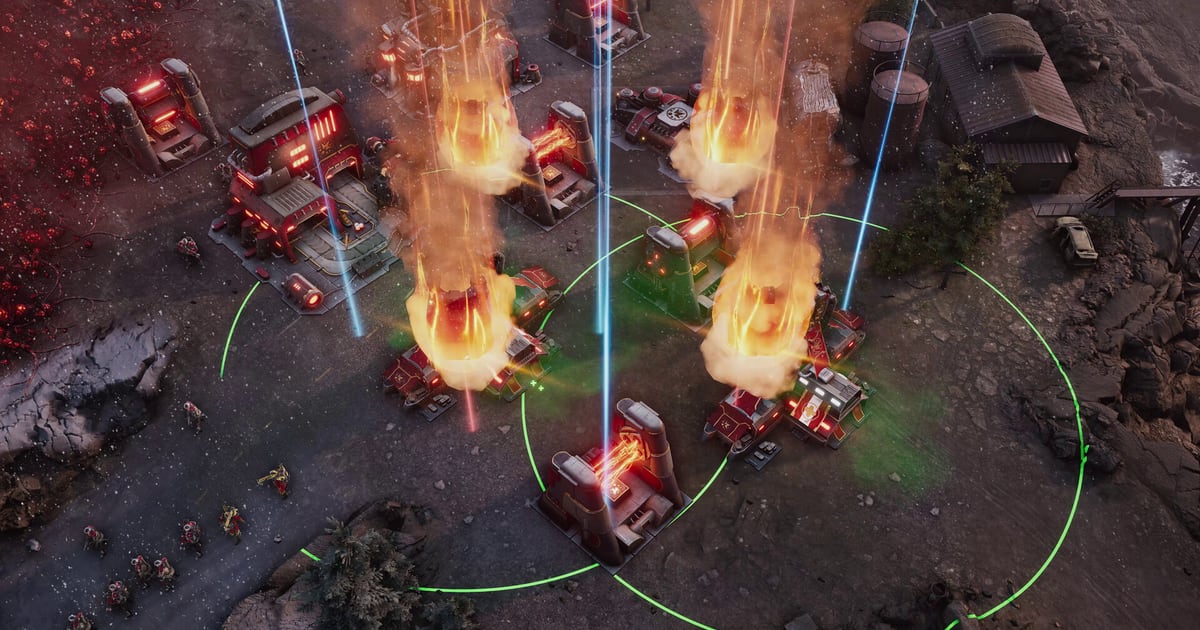
Beyond base construction and resource collection, military victories in Tempest Rising are decided by battlefield specialist micro and in-game Doctrine research. Factionfaction. An in-game group or nation players can align with or fight against, with its own goals and reputation system. arsenals do not consist of generic health-and-damage stat blocks; units carry activated specialist abilities, typed damage resistances, and lethal counters that punish mono-unit deathball armies.
What this covers: In-game Doctrine research trees, Specialist infantry abilities, weapon-type armor resistances, and Support Power call-ins. Why it matters: Rockets and cannons crack vehicles while fire and sniper rounds shred infantry — matching attack types to armor resistances melts pushes in seconds. Who should pick this: Commanders looking to out-micro opponents with active ability rotations.
Doctrine Research Specializations
Doctrines are in-game research upgrades, not pre-match picks: credit-funded levels in your faction’s tech trees that buff specific units, with the GDF researching Comms, Mobility, and Intel trees and the Dynasty researching Logistics, Aggression, and Security. (The campaign’s pre-mission Doctrine menu is a separate, campaign-only system.) Off-map Support Powers unlock separately, by building their prerequisite structures:
| Doctrine | Tree & Research Level | Effect | Tactical Role |
|---|---|---|---|
| Rapid Deployment (GDF) | Mobility level 1 · 800 credits | Structures are built 20% faster and return 50% bonus credits when sold | Fast expansions, forward staging |
| Resistant Treads (GDF) | Mobility level 2 · 800 credits | Harvesters move 20% faster, gain 25% health, and self-repair | An economy that survives early raids |
| Harvester Manufacturing (Dynasty) | Logistics level 1 · 800 credits | Harvester Wheels gain 30% health, rebuild 30% faster, and self-repair outside combat | Tempest Rigs that keep harvesting under pressure |
| Minefields (Dynasty) | Security level 3 · 1,500 credits | All ground vehicles and turrets drop a mine when they die | Attrition defense, map denial |
The GDF’s Tier 3 powers — the Communications Jammer, which silences enemy vehicle weapons, and the Tempest Air Strike — arrive through construction, never doctrine picks; even the orbital strike belongs to a building, the Drone Strike Station. The Dynasty’s capstone is the Tempest Instability Missile, a warhead that causes widespread damage and Tempest Overflow.
The Full Doctrine Trees
The four rows above are entry points, not the whole map. Each faction researches three trees, and the wiki indexes them in full:
| Faction | Tree | Doctrines |
|---|---|---|
| GDF | Comms | Boosted Comms, Armored Communicators, Manufacturing, Helmet Communicators, EM Interference, Ambush Protocols |
| GDF | Mobility | Rapid Deployment, Resistant Treads, Comms Rig Antenna, Triangulation, Aircraft Ascendance, Logistic Networks |
| GDF | Intel | Advanced Data Collection, Pinpoint Weaknesses, Efficient Intel, Virulent Scanners, Investment Durability, Regional Networking |
| Dynasty | Logistics | Harvester Manufacturing, Power Management, Logistics Improvements, Energetic Enhancements, Manpower, Planned Economies |
| Dynasty | Aggression | Body Armor, Training Regimen, Stockpiles, Empowered Dynamos, Officers, Leading the Charge |
| Dynasty | Security | Ordnance Manufacturing, Extended Life Generators, Minefields, Oversight, Defensive Operations, Frontline Construction |
A few of these do more than a percentage. The GDF’s Regional Networking makes your own dying units yield Intel, and Advanced Data Collection pays out when a Mark expires on an enemy. On the Dynasty side, Manpower is the attrition pick: while at least one Plan is running, most ground vehicles spawn a Missile Trooper when they die (the Voltaic Tank and Tempest Sphere spawn an Assault Gunner instead), so a losing trade still leaves bodies on the field — provided you stay under the population cap.
Support Powers: Built, Not Picked
Support powers are gated behind their prerequisite structures rather than the doctrine trees, which is why the Tier 2 set is the one most players will actually field:
| Faction | Tier 2 Support Powers |
|---|---|
| GDF | Support Beacon (temporary construction space plus Comms that Marks nearby enemies), Riot Drop (a Globetrotter drops a Riot Van carrying Field Scouts, Drone Operators, and Riot Troopers), Spy Drones |
| Dynasty | Call the Guard (drafts soldiers on short notice), Lockdown (forces buildings into a reduced-damage mode that blocks engineer captures but depowers and deactivates them) — plus the Tier 1 unlocks Field Infirmary (an emergency drill pod that heals nearby infantry) and Mine Drop (a minefield at the target location) |
Weapon-Type Resistances and Micro
Tanks in Tempest Rising do not simulate directional armor; damage is resolved by typed resistances:
- Typed Armor: Every unit and structure carries resistance percentages against six attack types — Rifle, Cannon, Rocket, Fire, Explosive, and Sniper. The tracked GDF Harvester, for instance, resists 75% of Rifle and Sniper damage but takes full damage from Cannons.
- Unit-Class Counters: Infantry are resilient against Rocket and Cannon fire but very vulnerable to Fire and Sniper attacks; vehicles shrug off Rifle and Sniper rounds and are countered by Rocket and Cannon attacks.
- Retreat Orders: There is no reverse-move command — the documented unit commands are Move, Attack move, Stop, Guard, Patrol, and Hold position — so pull damaged armor out with a plain Move order instead of waiting for a facing bonus that does not exist.
Armor Resistance by the Numbers
The wiki publishes the raw percentages, and they explain why an attack-type read beats a unit-count read. Three entries from the two faction lists:
| Unit / Structure | Rifle | Cannon | Rocket | Fire | Explosive | Sniper |
|---|---|---|---|---|---|---|
| GDF SG10 Harvester | 75 | 0 | 25 | 75 | 50 | 75 |
| GDF Refinery | 75 | 50 | 25 | 0 | 0 | 75 |
| Dynasty Tempest Rig | 75 | 0 | 25 | 75 | 50 | 75 |
Both harvesters take full Cannon damage and only 25% Rocket damage, so the anti-armor answer to an economy raid is a tank, not a rocket trooper. The Refinery inverts the picture — 0% Fire and 0% Explosive resistance — making it the softest structure in the GDF line to flame and demolition attacks. Aircraft sit outside the ground table entirely and are vulnerable to Rocket fire. Standard infantry also go prone under sustained fire at low health, cutting incoming damage at the cost of being immobile; heavy infantry never go prone and can only be crushed by heavy vehicles.
Commanding the Micro
Commanding that micro is deliberately narrow. Units can be given six orders — Move, Attack move, Stop, Guard, Patrol, Hold position — and Attack move, Guard, and Hold position are available only to armed units. Because there is no reverse-move, damaged armor retreats on a plain Move order. Units must also be stationary to attack and cannot fire while moving, while unarmed units use the passive Standoff Orders trait to keep their distance when moving with a group. Selection follows classic RTSRTS. Real-Time Strategy — a strategy game where everyone plays at the same time, continuously, instead of taking turns. convention: left-click or drag to select, right-click to move or attack, Ctrl+right-click to force-fire, and up to 10 control groups on the number keys.
Specialist Infantry Interactions
Infantry is not mere cannon fodder; specialists neutralize mechanized columns:
- GDF Engineer / Shieldmaiden: There is no GDF “Medic” or “Field Technician” — the Engineer repairs allied vehicles and commandeers enemy buildings, the Riot Medic keeps infantry alive while pinning enemies down with sonic suppression, and the Shieldmaiden deploys temporary repair pods that sustain armored pushes.
- GDF Grenadier vs Dynasty Ignitor: The Grenadier is a GDF tier-2 trooper whose grenades punish infantry and structures; the Dynasty’s garrison-clearing flame unit is the Ignitor, an AOE anti-infantry and anti-structure trooper.
- Snipers & the Hijacker: Snipers exist — the GDF Sniper eliminates high-priority targets from extreme range, and the Dynasty Operative is an anti-vehicle sniper — but they cannot one-shot vehicle crews. Vehicle capture is the GDF Hijacker specialist’s temporary Override ability, and Engineers and Technicians capture buildings, not vehicles.
The Full Specialist Roster
The counters above live on specific models. Both factions field support and elite specialists, and the wiki’s one-line roles map cleanly onto them:
| Faction | Specialist | Documented Role |
|---|---|---|
| GDF | Sniper (T2) | Mobile combat-control commando; removes high-priority targets from extreme range |
| GDF | Comms Officer (T2) | Provides Comms, Marks enemies on each attack, engages at range |
| GDF | Riot Medic (T2) | Keeps allied infantry alive and pins enemies with a sonic suppression weapon |
| GDF | Drone Assassin (T3) | Assassin Drones tear vehicles apart; can be detonated against light targets |
| GDF | Hijacker (T3) | Debuffs vehicles with Tempest Charge; temporarily seizes them with Override |
| Dynasty | Line Officer (T2) | Inspires infantry; enters an allied vehicle to raise its rank to Elite |
| Dynasty | Operative (T2) | Anti-vehicle sniper; also blunts enemy air |
| Dynasty | Machinist (T2) | Mobile Sensor Array that repairs allied vehicles |
| Dynasty | Physicist (T3) | Zone-control AOE specialist |
| Dynasty | Commando (T3) | Stealthy high-value-target eliminator |