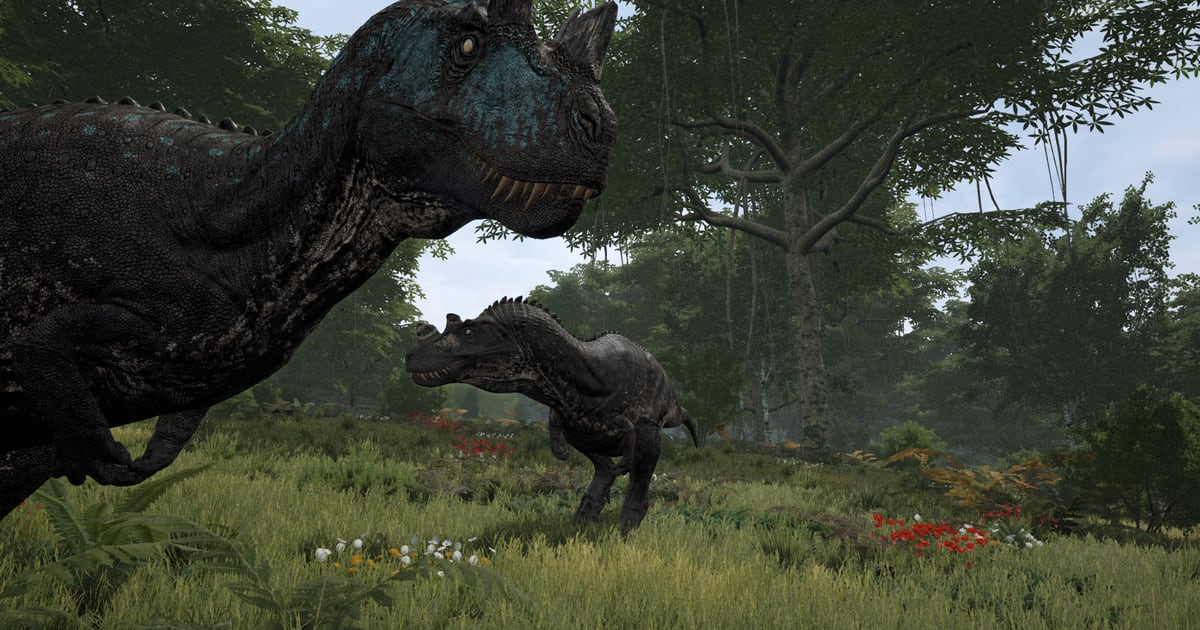
The Isle has no article on this site yet, so this one starts where new players get stuck: in the hour before the fight. It is an Early Access survival game from Afterthought LLC, on Steam since 1 December 2015, and Evrima — the build the patches target — is a recode that replaced the original rather than an iteration on it. The decisions that matter come before contact: where you eat, whether the walk to water is worth the exposure, and whether the animal in front of you has already outgrown you.
What this covers: how growth, diet, water and migration gate survival on The Isle’s Evrima branch at patch 0.21.772, which species hold up on a crowded server, and how to read a fight you should refuse. Why it matters: one exchange can end a body you spent an hour growing, so the players who last spend growth efficiently — and growth is the budget every death resets. Who should care: new players deciding whether to buy in during Early Access, and Legacy-era players returning to rules that no longer match their memory.
The build this primer assumes
Three different things look like “the game” from the outside, and only one is what you download by default.
| Branch or build | Status at time of writing | What it contains |
|---|---|---|
| Evrima Public Branch — 0.21.772 | Live. Deployed 4 August 2026, still the most recent patch announcement in the official Steam news feed | Elder life stage, entombment, mutations, pteranodon flight, Tyrannosaurus and Allosaurus |
| HordeTest | Separate test branch, redeployed per cycle | Migration rework, Entomb Save, Oviraptor and Baryonyx. DevBlog #73 (30 September 2026) calls Oviraptor “almost complete” |
| Legacy | The pre-recode build, still referenced when old skins return (DevBlog #71) | The original game — not the systems described here |
Everything below assumes 0.21.772 on the Evrima public branch; the newest official post is DevBlog #73, with no patch announcement after it. If you read this later, check the version on the announcement first. Steam’s public count endpoint returned 20,445 concurrent players while this was written — on servers the config caps at 100 by default.
Growth is the real difficulty curve
Combat is short and mostly decided before contact. Growth is the long game: a character starts as a hatchling, passes through juvenile and subadult stages, reaches adult, and — since patch 0.21.321 in December 2025 — can continue into an elder life stage. Growth is tracked as a percentage, and abilities are gated on it: patch 0.21.321 lists Tyrannosaurus’s Ambush as “Spacebar (After achieving subadult)” and its Paleo vocals as unlocking only “after achieving adult”.
The top of that curve is unusual. At 100% growth a player becomes eligible to Entomb, which the notes describe as killing “your current animal” and respawning you “again as a fresh spawn of the same species”, with mutations kept and their benefits enhanced. A full-grown animal is therefore not a trophy you park; it is a resource you eventually spend.
The rules that decide how fast you get there have all been rewritten after feedback. Diet feeds growth only up to adulthood: patch 0.17.54 set the diet growth bonus to cap at 300%, and DevBlog #63 (October 2025) closed the other end — “When players grow to adult, any growth bonuses from diets will no longer apply (the rest of your diet buffs will remain unaffected).” Elders were rebalanced twice after that: DevBlog #65 removed the growth speed elders got from diets, and DevBlog #68 reframed the target so that “more of an animal’s lifetime will be spent at its peak physical condition (adult or prime stats) before their attributes begin falling off.” Transitions are still being repaired too — 0.21.772 fixed players being able to “unintentionally acquire prime elder after 75% growth”, which tells you prime elder is meant to sit later than that.
Breeding has its own deadline. Patch 0.21.321 made “larger animals” infertile at 100% growth; DevBlog #65 later exempted Beipiaosaurus, Dryosaurus, Hypsilophodon and Troodon, because they “would grow so quickly that they did not have ample time to create a nest”. If you want to nest, the window closes as the bar fills — except on those four, where the developers decided that was unfair.
| Phase | What changes | The mistake it punishes |
|---|---|---|
| Hatchling to juvenile | Lowest stats, fastest relative growth, full diet growth bonus | Crossing open ground because the map looks empty |
| Subadult | Stage-gated abilities start unlocking (Tyrannosaurus’s Ambush is the published example) | Taking a fight you would win at adult, at half the body |
| Adult | Diet growth bonuses stop (DevBlog #63); larger species become infertile at 100% (0.21.321) | Treating adulthood as the finish line and stopping the food rotation |
| Elder / prime | Attributes peak, then decay toward entombment (DevBlog #68) | Spending the elder window on travel |
Diet: the bonus is the plan, not the food
The diet system is a nutrition-target system, not a hunger bar with better art. DevBlog #52 (October 2024) describes removing the old slot ritual: “slots no longer need to be activated anymore, the bonuses are scaled with the amount of nutrients until a defined maximum.” DevBlog #53 added the part that catches new players: “The stomach grows with the dinosaur and food no longer scales with the stomach” — which, by the developers’ own account, forces large animals with quick growth spurts to “eat far more often.”
The trap is eggs. DevBlog #53 brought them into the diet system so carnivores could rob nests, then patch 0.21.321 states flatly that “Eggs no longer give nutrients” on the public branch. Oviraptor is being built on the opposite premise — DevBlog #68 calls it an “egg-thief” that scents “active nests of other species” — but that is HordeTest work. Do not build a diet around eggs on 0.21.772.
Water: the budget the roster does not share
Water is where the roster stops being a list of skins. Official notes treat saltwater as a liability: patch 0.15.191 fixed “thirst going up in saltwater after swimming directly into it from freshwater” and fixed Deinosuchus and Ceratosaurus “vomiting when drinking saltwater”. That patch’s config also names hydration-linked mutations — Sustained Hydration, Xerocole Adaptation, Reniculate Kidneys, Wader, Hydroregenerative — each with a value an owner can change. That list is from August 2024 and has moved since (0.21.720 removed Traumatic Thrombosis “for future reintegration”), so read your status screen.
Thirst decay is set per species and adjusted per species. DevBlog #64 (November 2025) records in one breath that “Maiasaura thirst decay has been reduced” and that its crowd control needed work. A herbivore’s water budget is a lever the developers turn, not a universal constant.
Migration zones, and what they do to your diet
On the live branch, migration is a server-side feature: the config published with 0.15.191 exposes bEnableMigration (“Enable patrol zones, species migrations, and mass migrations”), and the 0.17.54 notes replace its duration key with SpeciesMigrationTime=10800 and add bEnableMassMigration, MassMigrationTime=43200, MassMigrationDisableTime=7200 and bEnablePatrolZones=true. DevBlog #52 is candid about the first iteration — always on, no downtime between zones, it produced a “keep moving or starve” experience unless you supplemented your diet elsewhere.
The rework changes the shape of it. The director’s note in DevBlog #71 is the clearest statement of intent published: “Individual player migrations are added, moving players around the map on an individual level instead of a persistent species migration that calls everyone to a location.” Then the line that matters for growth: “being in your migration zone directly relates to your nutrition intake/conversion when consuming food on your diet.” That link belongs to the build on HordeTest, not to a rule you can plan around on 0.21.772. What holds on both is the logic: the right food in the wrong place is worth less than the right food where the game wants you.
Picks that survive a crowded server
The store page advertises “servers featuring up to 100+ players”, while the config block sets MaxPlayerCount=100 with the comment “100+ player servers is not recommended”. Either way the design assumes competition for the same carcasses, nests and water, and the pick that survives is rarely the biggest one.
| Pick | Confirmed trait (source) | Why it holds up in a crowd | What it gives up |
|---|---|---|---|
| Dryosaurus | “tiny darting herbivore” (store page); one of four small species exempted from 100%-growth infertility (DevBlog #65) | Cheap to replace, fast to regrow | Cannot contest anything |
| Pteranodon | Adult weight set to 90 kg (0.21.720); daytime spearfishing, barrel roll and air brake (0.21.321); aerial stamina costs lowered (DevBlog #64) | Leaves the ground game and fishes its own diet | A “violent ground game” is still to come |
| Austroraptor | Added in 0.21.772 with a pounce, a water jump from the surface and daytime spearfishing; “more fragile” than Omniraptor (DevBlog #68) | Water is an escape route, and fish need no kill | No unique attacks while latched |
| Kentrosaurus | Added in 0.21.720 with passive reflection damage on its tail and shoulder spikes | Punishes the swarm a crowd produces | Only punishes contact |
| Deinosuchus | Buoyant in water, unlike Baryonyx’s passive sinking (DevBlog #72); has a lunge (DevBlog #73) | A private lane most of the roster cannot follow into | Exposure between water bodies |
| Tyrannosaurus | Added in 0.21.321 with Muzzle Swing, Crush and stage-gated Ambush; no longer capable of “punching upward and pinning massive targets” (DevBlog #63) | Ends a fight in one exchange when the weight maths is with you | Ambush does not unlock until subadult |
| Allosaurus | Added in 0.21.321 with a heavy-bleed Claw Swipe and a Pounce that latches, dealing “increasing damage and bleed over time” | Cheapest way to turn a mid-weight body into kills | Damage is a clock, not a burst |
If you are testing before committing, the store page notes that Sandbox mode “lets you play an expanded roster of dinosaurs” with no major penalties for dying — the honest way to check whether an animal’s movement fits your hands, because Survival charges a full lifecycle for the answer.
How to read a fight you should not take
Fight-reading here is mostly knowing which of an opponent’s abilities is gated behind a body size you do not have. The notes are explicit about it, because the developers keep fixing cases where the gate failed.
Start with the crush. Patch 0.21.321 describes Tyrannosaurus’s Crush as an attack that “can pin and execute smaller or wounded targets, or stagger similar sized animals”, and the follow-up Throw as a move that “will always kill them”. DevBlog #62 lists “crush weight thresholds not working correctly” among the bugs it closed. If you are small, wounded, or both, the crush is an execution and distance is the only correct play.
Second, mind the front of your animal. Patch 0.21.321 fixed the “pounce deflect animation not playing when hitting the front of a target” — a pounce into a facing target can be deflected, which makes facing a pouncer a mechanic, not a reflex.
Third, respect damage over time as its own loss condition. Allosaurus’s latch deals increasing damage and bleed, and 0.21.720 fixed “an input lock that could happen after a player dies from bleed”. Against a latching predator, standing still is losing slowly.
Fourth, treat reflection as terrain. Kentrosaurus punishes contact with its spikes, and 0.21.772 fixed ranged attacks incorrectly triggering reflection and bleed. The intended shape is a body that hurts you for hitting it — the same logic a crowded server runs on at scale. For a wider frame on ranking threats before you commit, the ARC Raiders threat-tier breakdown is a useful parallel read: the ranking discipline transfers even though nothing else does.
And expect the pounce maths to move. DevBlog #66 (January 2026) says balance changes are coming to “Bucking and Grapple/Pin, since bucking hasn’t met the mark for either side of pounce interaction”, and DevBlog #65 notes damage, knockdown thresholds and fracture modifiers were retuned across the larger species.
Reading the server, not just the map
The server config is published in the patch notes, and it explains most of the difference between two servers that look identical in the browser.
| Setting (published with 0.15.191) | What it controls | Why it matters |
|---|---|---|
MaxPlayerCount=100 | Player cap; the note adds “100+ player servers is not recommended” | Population density is the real difficulty setting |
GrowthMultiplier=1 | “Universal multiplier for growth… Recommendation is no higher than 20” | A 5x server is a different game |
bEnableMigration, bEnablePatrolZones, SpeciesMigrationTime=10800, bEnableMassMigration, MassMigrationTime=43200, MassMigrationDisableTime=7200 | Patrol zones, species migrations, mass migrations, and their durations (the duration key was renamed in 0.17.54) | Whether the map pushes you around or lets you camp |
bEnableMutations | Mutation system on or off, with per-mutation values | Hydration and digestion modifiers live here |
AllowedClasses= (one per species) | Which species may spawn at all | A server can remove your planned animal |
Two layers sit outside that file. The elder system can be switched off entirely — DevBlog #63 states owners “will have several options to alter or remove its impact”, and that “the system may be turned off entirely to remain an immortal adult forever”. Unofficial servers add conduct rules on top of the mechanical ones, and neither is visible from the species select screen, so spend your first five minutes on a new server reading its rules.
What this primer does not claim
The Isle publishes no roster page I could fetch — the store page says “dozens of unique creatures”, and species get named as they ship — so the species table lists only animals named in official 2026 posts. Growth times in minutes are not published anywhere I could verify, so any figure you see elsewhere is community measurement or a Legacy-era number. And the config values are quoted from 0.15.191, the last full block posted in the news feed.
What is confirmed is the shape of the problem. Every death costs a lifecycle, and that lifecycle is fed by food you have to find, water you have to cross open ground for, and fights you have to decline. The dinosaur is the last decision, not the first.