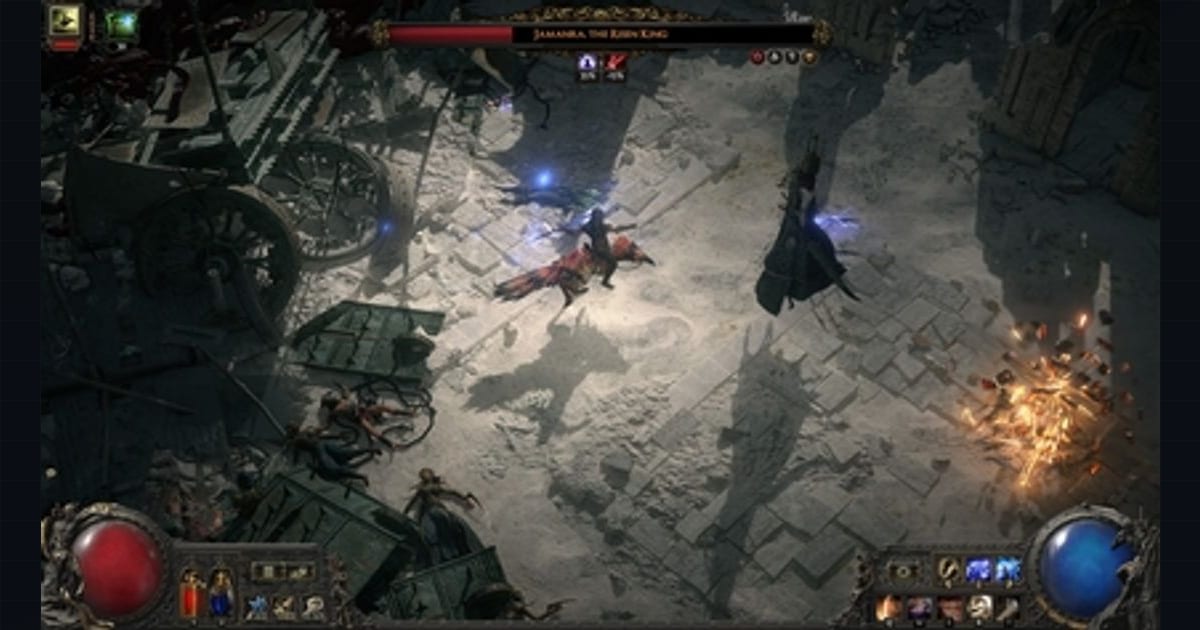
Path of Exile 2’s 0.3 patch lands midway through Early Access with two intertwined goals: rebalance the ascendancy subclasses that define mid-game build identity, and adjust the economy levers that govern how quickly a fresh league reaches its mapping phase. Neither change exists in isolation — an ascendancy nerf only matters relative to how expensive it is to gear, and an economy tweak only matters relative to which builds can exploit it. This analysis separates the mechanics from the meta read.
What it covers: The 0.3 rebalance — ascendancy changes and economy levers, separated from the meta read. Why it matters: An ascendancy nerf only matters relative to gearing cost; the two systems intertwine. Who should pick this: Early Access players planning a league start.
What the 0.3 Patch Targets
Grinding Gear Games has been iterating on PoE2 in roughly monthly cadence since the December 2024 Early Access launch. The 0.3 build focuses on three pressure points the community flagged through the prior cycle:
- Ascendancy throughput and defense imbalances — several subclasses were either trivializing content or dead on arrival.
- Gold and currency sinks — early-league inflation was outpacing the rate at which gold could be spent on meaningful progression.
- Trading friction and identify costs — the barter-and-gold hybrid economy needed recalibration so league starts didn’t bottleneck on identification RNG.
The patch is not a full systems overhaul (that work is reserved for the eventual 1.0 launch). It is a tuning pass — but tuning passes in PoE2 move the league-start meta more than new content drops do, because they change which builds are viable cheaply.
Ascendancy Reworks
Ascendancies in PoE2 are unlocked through the Trial of the Sekema and Trial of the Chaos, which replace the original game’s Labyrinth runs. Each base class branches into two or three ascendancy subclasses, and the 0.3 patch touches many of them. The reworks fall into three categories: throughput nerfs, defense redistribution, and mechanic simplification.
Throughput Nerfs to Overperformers
The subclasses that dominated the prior league cycle — typically the ones with multiplicative damage scaling baked into a single notable — received flat reductions or conversion to conditional bonuses.
- Infernalist (Witch): The sacrifice-and-demon mechanic retained its identity but lost some of its unconditional damage multiplication. Demon form’s spell-damage scaling was reworked to tie more tightly to its Demonflame resource, shifting emphasis from passive uptime toward active management. This pushes the build from “always-on multiplier” toward “windowed burst,” which is a healthier design but a slower league starter.
- Blood Mage (Witch): Life-cost mechanics were retained, but the efficiency of blood skills relative to mana skills was brought closer to parity. The prior cycle saw Blood Mage crowd out other Witch options because the life-as-resource pool had proven more efficient to scale than mana-based alternatives.
- Deadeye (Ranger): Projectile and chaining bonuses were trimmed. Deadeye remains the ranged-throughput pick, but the gap between it and the Ranger’s other ascendancy options narrowed, making the alternative a more viable choice.
The design intent is visible: GGG wants ascendancy choice to be a build-shaping decision, not a throughput-maximizing one. When one subclass does 20–30% more damage than its sibling with the same gear, the choice isn’t a choice — it’s a spreadsheet answer.
Defense Redistribution
Several ascendancies had their survivability notables restructured. The pattern across the patch: shift unconditional damage reduction toward conditional or uptime-gated defense.
- Titan / Warbringer (Warrior): Armor and block-related notables were adjusted so that the defensive payoff carries a tradeoff rather than being pure passive stat stacking.
- Stormweaver (Sorceress): Energy-shield and mana-guard notables were rebalanced. The prior version leaned on a single notable for its mana-as-defense identity; the rework reframes that defense around active mana management, raising the opportunity cost.
The practical effect: builds that relied on one ascendancy notable for their entire defensive layer now need a second notable or a gear investment to reach the same ceiling. This is the most consequential change for league-start planning, because defense is the thing that kills you in the first 12 hours.
Mechanic Simplification
A few ascendancies had notables that were mechanically dense but low-impact — fiddly conditional triggers that rarely fired. The 0.3 patch consolidates these into fewer, more readable notables.
- Acolyte / Ritualist lines (Witch and Monk adjacent): Several dense conditional-trigger notables were consolidated into broader, more readable triggers, reducing the number of edge cases where a bonus failed to apply.
This category has the lowest meta impact but the highest quality-of-life impact. It won’t change which build tops the ladder, but it reduces the number of bug-report threads about “my notable didn’t proc.”
Economy Shifts
The economy changes are where 0.3 most affects the average player’s first week. PoE2’s Early Access economy runs on a gold-plus-currency hybrid: gold covers fixed costs (identify, respec, waypoint unlocks), while currency items drive crafting and trade value. The patch adjusts both sides.
Gold Sinks and Inflation Control
Prior cycles saw gold accumulate faster than players could spend it, because the meaningful sinks (respect costs, certain vendor recipes) didn’t scale with income. The 0.3 patch reportedly increases several sink rates and adds new gold-sink mechanics.
- Respec costs: Reclaiming passive points carries a gold cost, creating a soft commitment to your tree rather than a free redo. This makes early passive allocation matter — you can’t freely respec into your ascendancy-optimized tree at level 60 without paying for it.
- Vendor identify economy: Identification mechanics were adjusted, with identify currency remaining the primary method and gold-based identification as an emergency fallback rather than the default.
The inflation-control angle: if gold sinks scale with character progression, the gold that floods in from late-game content gets absorbed instead of pooling. This stabilizes trade valuations that are denominated in gold-equivalent terms.
Currency and Trade Adjustments
- Trading friction: The patch adjusts trade mechanics, aimed at reducing the scam-surface and bot arbitrage that distorted early-league pricing. Exact mechanics depend on the trade-league implementation, which GGG has iterated on more than once.
- Currency drop tuning: Several currency items had their drop-rate weights adjusted. The community-consensus read is that lower-tier currency availability was increased while mid-tier crafting currencies were held flat or slightly reduced. The net effect: more raw crafting attempts available, but fewer high-value currency items per hour — which raises the value of targeted crafting over brute-force spam.
League-Start Economic Implications
The combined effect of gold-sink increases and currency tuning is a slower, more deliberate league start. Players who treat the first 48 hours as a sprint to maps will feel the respec-cost increase most acutely, because aggressive early passive experimentation now carries a gold tax. Players who plan a passive tree that holds up through the ascendancy unlock will spend less and arrive at mapping with more currency reserves.
Early-League Planning Implications
Pulling the ascendancy and economy threads together, the 0.3 patch reshapes league-start planning along two axes.
Build Selection: Favor Defense-Complete Ascendancies
Because the defense redistribution removed single-notable defensive layers, the safest league-start builds are those whose ascendancy provides defense across multiple notables or whose base class kit covers defense independent of ascendancy. Builds that leaned on one ascendancy notable for their entire survivability window now need either a second notable or a gear breakpoint — and at league start, gear breakpoints are expensive.
The throughput nerfs mean the gap between “best” and “viable” ascendancies narrowed. A build that was 15% behind the top pick last cycle may now be within 5%, and if it has a cleaner defensive profile it becomes the better league-start choice despite lower ceiling damage.
Economic Planning: Front-Load Passive Commitment
The respec-cost curve rewards committing to a passive tree early. The optimal play is:
- Pick an ascendancy whose notables you will actually use by level 40–50, not one you’ll respect out of.
- Minimize experimental passive allocation in the first two acts — every point you later reclaim costs gold that could fund waypoint unlocks and vendor crafting.
- Treat identify currency as a budget line item. With gold identify costs raised as a fallback, burning currency on identification eats into your crafting reserves.
Mapping On-Ramp Timing
The currency tuning suggests mapping will begin at a comparable gear level to prior cycles but with less currency surplus. Players who rush maps under-geared will burn currency on death recovery and repeated portal use; players who over-gear in the campaign will spend less overall. The patch tilts the math slightly toward “finish the campaign with a solid kit” over “skip to maps and grind it out.”
What the Patch Does Not Address
Notably absent from 0.3: endgame content expansion, new boss encounters, and the full trade-system overhaul that GGG has signaled for the 1.0 launch. The ascendancy and economy work is prerequisite to that — you can’t balance new endgame content against a meta where one ascendancy does 30% more damage and gold has no sink. The 0.3 patch is foundation work, not feature work, and reading it as such sets the right expectations.
Sources & further reading
- Path of Exile 2 official site — https://pathofexile2.com/
- Path of Exile patch notes forum — https://www.pathofexile.com/forum/view-forum/patch-notes
- Path of Exile 2 Steam store page — https://store.steampowered.com/app/2694490/Path_of_Exile_2/
- Grinding Gear Games developer blog — https://www.pathofexile.com/forum/view-forum/developer
- Path of Exile wiki (community-maintained) — https://www.poewiki.net/
Next read
- For picking the class first, see Path of Exile 2: Class Selection and 0.3 Tier List.
- For one class in depth, see Path of Exile 2: Witch Ascendancy.
- All our coverage lives on the Path of Exile 2 hub.