RX 9070 XT vs RTX 5070 — 1440p Value, Ray Tracingray tracing. A rendering technique that simulates how light bounces, for realistic shadows, reflections, and lighting — costly to compute. & FSR 4 Catch-Up
Two mid-range flagships entered 2025 aimed squarely at the 1440p ultra crowd: AMD’s RX 9070 XT (RDNA 4) and NVIDIA’s RTX 5070 (Blackwell). Both target the same resolution and the same price band, but they get there through materially different silicon philosophies — AMD leaning on raw raster throughput and a larger VRAMVRAM. Video RAM — memory on the graphics card used for textures and frames; more of it lets you run higher settings. buffer, NVIDIA betting on ray tracing efficiency and a mature DLSS 4 stack. A year and a half of driver maturity and FSR 4 adoption later, the gap has narrowed in ways that matter for anyone buying in 2026.
What it covers: RX 9070 XT vs RTX 5070 at 1440p ultra — raster, ray tracing, FSR 4 catch-up, and value. Why it matters: Eighteen months of drivers and FSR 4 adoption narrowed the launch-day gap; the 2026 verdict differs from the 2025 one. Who should pick this: Mid-range buyers choosing between AMD raster headroom and NVIDIA feature maturity.
The Hardware Divide
RDNA 4 — AMD’s Raster Bet
The RX 9070 XT is built on AMD’s RDNA 4 architecture, the first generation to dedicate real silicon to hardware ray tracing acceleration beyond the foundational ray engines of RDNA 3. AMD restructured the ray tracing pipeline with what it calls “radiance cache” ray tracing and doubled down on BVH traversal efficiency. On paper, the 9070 XT carries 64 compute units, 16GB of GDDR6 across a 256-bit bus, and a 304W TDP. The 16GB frame buffer is the standout spec — at 1440p ultra with high-resolution texture packs, it eliminates the texture-streaming stutter that plagues 8-12GB cards in modern open-world titles.
Blackwell — NVIDIA’s Efficiency Play
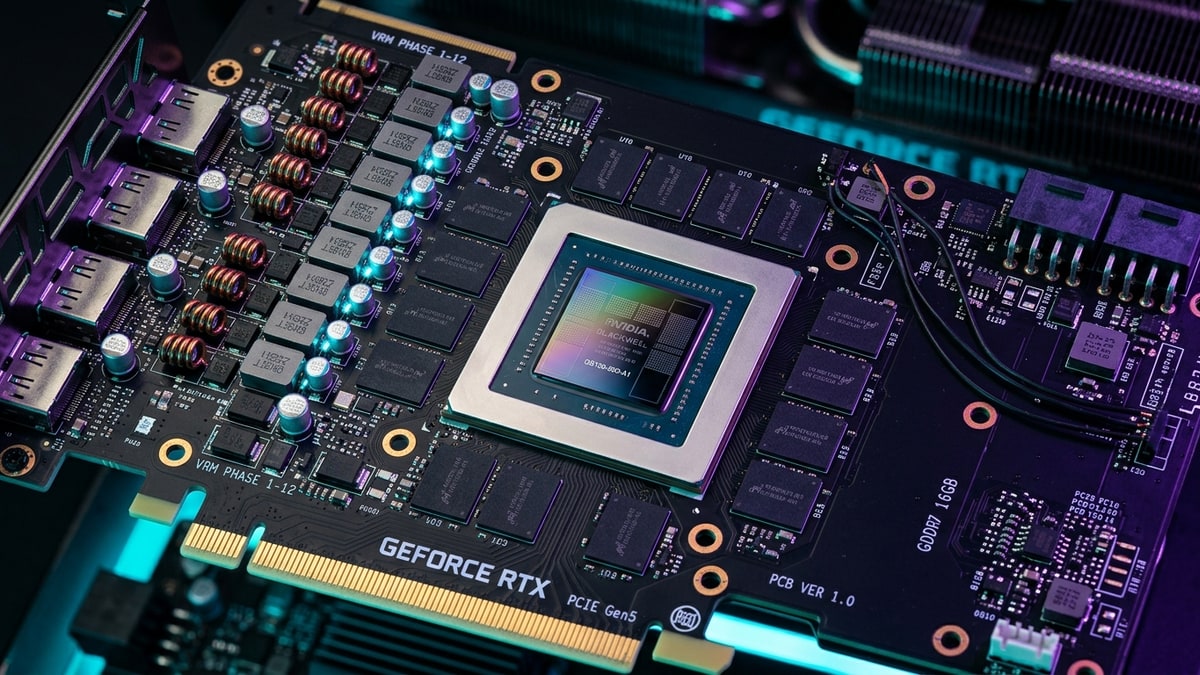
The RTX 5070 ships on NVIDIA’s Blackwell architecture with 12GB of GDDR7 across a 192-bit bus and a 250W TDP. GDDR7’s higher per-pin bandwidth partially compensates for the narrower bus, and Blackwell’s 4th-generation RT cores and 5th-generation Tensor cores improve ray tracing and AI upscaling performance per watt. The 12GB buffer is the card’s clearest weakness at 1440p — sufficient today, but a constraint under ray-traced titles with heavy texture loads, especially as games ship 4K texture packs by default.
1440p Ultra — Raw Raster Showdown
At 1440p ultra with no upscaling, the RX 9070 XT generally leads the RTX 5070 in pure rasterization workloads. AMD’s compute density pays off in shader-heavy titles where the difference between the cards is measurable rather than perceptual.
| Title (1440p Ultra, no upscaling) | RX 9070 XT avg fpsframerate. How many images (frames) the game shows per second; higher = smoother motion. 60 fps is a common target. | RTX 5070 avg fps | 1% low gap |
|---|---|---|---|
| Cyberpunk 2077 (RT off) | ~95 | ~82 | 9070 XT ~+12% |
| Black Myth: Wukong | ~78 | ~72 | 9070 XT ~+8% |
| Alan Wake 2 (RT off) | ~88 | ~80 | 9070 XT ~+9% |
| Hogwarts Legacy | ~112 | ~104 | 9070 XT ~+7% |
| Monster Hunter Wilds | ~68 | ~65 | Within margin |
Numbers above are approximate aggregate figures from multiple review outlets at launch and through 2025 driver updates — treat specific values as directional rather than exact. The pattern is consistent: AMD holds a single-digit-to-low-double-digit raster lead, and that lead widens in shader-bound scenes. The 1% low advantage is the more telling metric — the 9070 XT’s 16GB buffer keeps frame times flatter when texture streaming kicks in.
Ray Tracing — Where NVIDIA Pulls Ahead
Flip on ray tracing and the picture inverts. Blackwell’s RT cores handle BVH traversal and ray-box intersection more efficiently than RDNA 4’s ray accelerators, and NVIDIA’s longer investment in RT pipeline optimization shows up in both average frame rates and frame-time consistency.
RT Heavyweights
In titles with heavy RT implementations — Cyberpunk 2077’s RT Overdrive/Path Tracing, Alan Wake 2’s full RT, and Metro Exodus Enhanced — the RTX 5070 outperforms the 9070 XT by a meaningful margin at 1440p with RT on, before upscaling. Cyberpunk 2077 with path tracing enabled is the extreme case: neither card hits 60 fps native at 1440p, but the 5070 lands notably closer and responds better to DLSS 4’s multi-frame generation.
AMD closed some of the RT gap with RDNA 4 — the 9070 XT is meaningfully faster than the 7800 XT was in RT workloads — but NVIDIA’s generational lead in dedicated ray tracing hardware remains intact. For buyers who prioritize ray tracing as a primary visual feature, the 5070 is the stronger raw performer.
FSR 4 vs DLSS 4 — The Catch-Up Story
The upscaling conversation is where this comparison has shifted most since launch. DLSS 4 launched with a clear lead: superior image quality, better temporal stability, and multi-frame generation that can multiply frame rates 2-3x in supported titles. FSR 4, debuting with RDNA 4, was AMD’s first machine-learning-based upscaler, abandoning the hand-tuned heuristics of FSR 1-3 in favor of an ML model trained for RDNA 4’s AI accelerators.
Image Quality Convergence
Through 2025 and into 2026, FSR 4 closed much of the image-quality gap with DLSS 4. Early FSR 4 implementations showed visible ghosting and temporal instability in high-motion scenes; subsequent driver and game-patch updates narrowed those artifacts significantly. In side-by-side comparisons at 1440p output (running at 1080p internal), FSR 4’s image quality has moved much closer to DLSS 4 in static or slow-motion scenes.
The remaining DLSS 4 advantages are subtle: marginally better reconstruction of thin geometry (fences, power lines, hair), slightly better anti-ghosting in fast camera pans, and the multi-frame generation pipeline, which is more mature on NVIDIA’s side. AMD’s frame generation — now ML-based in FSR 4 — has improved but still trails in edge cases involving UI elements and very high motion.
Ecosystem Adoption
DLSS 4 benefits from NVIDIA’s deeper developer relationships and broader plugin integration. More games ship with DLSS 4 support at or near launch than FSR 4, though AMD’s broader FSR 4 integration efforts have expanded coverage. For a 1440p buyer in 2026, the practical difference: if your must-play list skews toward titles with day-one DLSS 4 support, NVIDIA’s upscaler is the safer bet. If you play a broad library where upscaler support varies, FSR 4’s improving coverage and the 9070 XT’s raster headroom make AMD competitive.
FrameTime Analysis — Consistency Matters
Average frame rate tells part of the story; frame-time consistency tells the rest. The 9070 XT’s 16GB VRAM buffer is its strongest frame-time asset at 1440p. In games like Hogwarts Legacy, Alan Wake 2, and Cyberpunk 2077 with high-resolution texture packs, cards with 12GB or less exhibit periodic frame-time spikes when the engine streams textures past the buffer — visible as micro-stutters even when the average fps looks healthy. The 9070 XT largely avoids this.
The RTX 5070’s frame times are generally tighter in RT-heavy workloads thanks to better RT core throughput, but the 12GB buffer creates a ceiling. In titles that exceed 12GB at 1440p ultra with RT — increasingly common in 2025-2026 releases — the 5070 either falls back to system memory (severe stutter) or the engine aggressively reduces texture streaming, trading visual fidelity for smoothness. This is the core argument for the 9070 XT in a longevity-focused 1440p build.
Value Proposition — Price, Power, Longevity
RX 9070 XT — The Longevity Play
- Strengths: 16GB VRAM, stronger raster, flatter frame times in VRAM-heavy titles, improving FSR 4.
- Weaknesses: Higher TDP (304W vs 250W), weaker RT performance, narrower upscaler ecosystem.
- Best for: 1440p buyers who prioritize raster performance, want a buffer that won’t choke on future texture packs, and play a wide game library.
RTX 5070 — The RT and Upscaler Play
- Strengths: Stronger ray tracing, mature DLSS 4 with multi-frame generation, lower power draw, broader developer adoption.
- Weaknesses: 12GB VRAM ceiling, lower raw raster, higher street price in constrained supply.
- Best for: 1440p buyers who prioritize ray tracing, want the best upscaling ecosystem, and play titles with strong DLSS 4 integration.
The 2026 Verdict
At launch, this comparison favored NVIDIA on feature maturity and AMD on raw raster and VRAM. In 2026, FSR 4’s catch-up has eroded NVIDIA’s upscaler advantage to a narrower margin, while the VRAM gap has grown more relevant as 2025-2026 releases push texture budgets higher. The deciding factors now:
- If ray tracing is a primary visual priority: RTX 5070. NVIDIA’s RT core advantage is real and persistent.
- If longevity and frame-time stability at 1440p ultra matter most: RX 9070 XT. The 16GB buffer is future-proofing that pays off today in texture-heavy titles.
- If upscaler ecosystem breadth is critical: RTX 5070, but the gap is narrowing as FSR 4 adoption expands.
Both cards deliver competent 1440p ultra performance. The 9070 XT wins on raster and VRAM headroom; the 5070 wins on ray tracing and upscaler maturity. The “better” card depends on which of those dimensions you weight — and in 2026, that’s a closer call than it was at launch.
Sources & further reading
- AMD Radeon RX 9070 XT product page — https://www.amd.com/en/products/graphics/desktops/radeon/9000-series/amd-radeon-rx-9070xt.html
- NVIDIA GeForce RTX 5070 product page — https://www.nvidia.com/en-us/geforce/graphics-cards/50-series/rtx-5070-family/
- AMD FSR 4 technical documentation — https://www.amd.com/en/technologies/fidelityfx-super-resolution.html
- NVIDIA DLSS 4 overview — https://www.nvidia.com/en-us/geforce/ai/dlss/
- TechPowerUp RX 9070 XT review — https://www.techpowerup.com/review/amd-radeon-rx-9070-xt/
- Hardware Unboxed RTX 5070 benchmark coverage — https://www.youtube.com/@HardwareUnboxed
Next read
- For the full upscaler stack behind this matchup, see DLSS 4 vs FSR 4 vs XeSS 2: The 2026 Upscaler Comparison.
- For the VRAM argument in AMD’s favor, see VRAM Tiers 2026: 1440p vs 4K Stuttering.
- For AMD’s late-2026 price moves on this generation, see RX 7000 Price Cuts and 2026 Used Value.