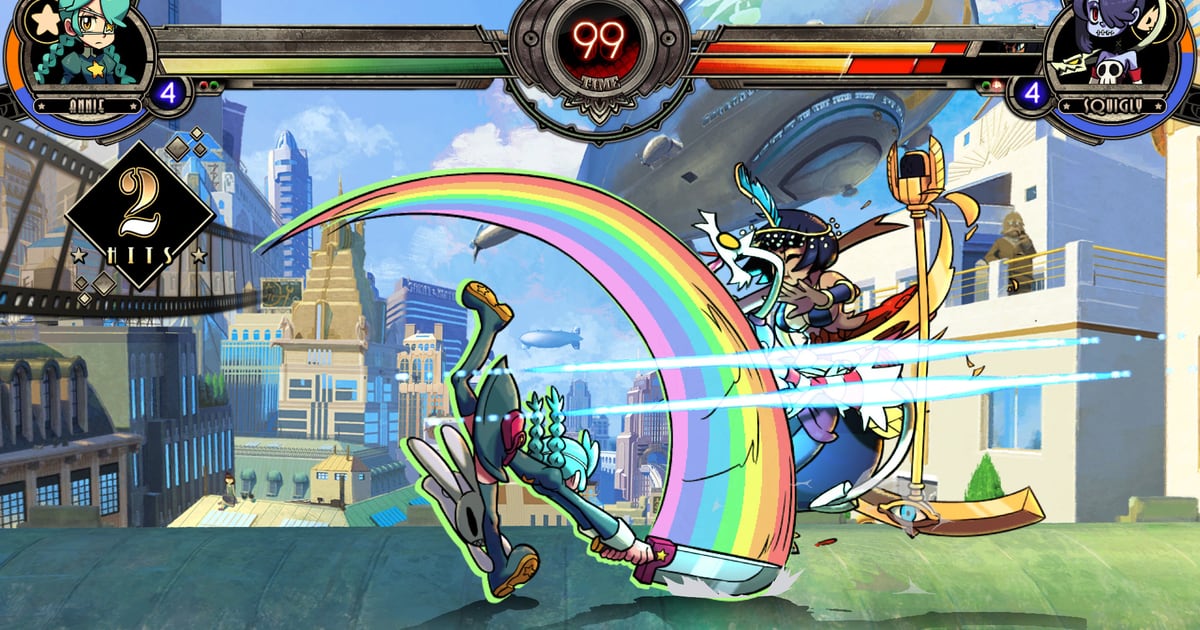
Skullgirls is a tag fighter that launched on Xbox Live Arcade in April 2012 and still takes patches; 2nd Encore is its 2015 revision. Its anti-infinite design is the part that needs explaining: instead of banning long combos, the game keeps a running number on the defender and lets the attacker decide what to do about it.
Our rollback and netcode glossary records the one thing most modern write-ups say about the game — that it lets players pick their own delay frames rather than fixing a universal value. That piece is about the connection. This one is about the resource, and the team-size decision you lock in before you have chosen a single character.
What this covers: the Drama (Undizzy) gauge — what adds to it, what subtracts from it, and the damage penalties that fire at Max Drama in retail version 3.7.14 — plus the IPS stage counter and the solo/duo/trio maths. Why it matters: the numbers everyone quotes for this system changed on 28 May 2024, and most explainers predate that patch. If your source says 55% is the penalty for a combo that starts at Max Drama, it is out of date. Who should care: players coming to the game from 2XKO or Marvel Tōkon who assume a team fighter’s combo rules are fixed, and anyone deciding between a solo character and a trio.
The premise is half right, and the patch archive proves it
The tidy version is that Skullgirls solved infinite combos architecturally, so it never had to patch them. The second half of that is false, and the developers said so themselves. Hidden Variable’s 5 April 2024 beta notes introduce another layer with this sentence:
“Carrying on the tradition of adding more layers to IPS and Undizzy systems when they are not protecting players effectively, we are stepping in and stopping sluggish, long, looping combos at 240+ Undizzy that end in a Burst Bait / Throw (back into itself) in a pretty heavy handed way.”
That is a studio describing iterative repair, not a closed problem. What Skullgirls built is a budget: a number that rises while you are being combod, caps out, and then changes the arithmetic of the combo you are in. It is enforced by software rather than a banned-move list, and every layer of it has a patch note behind it.
Three counters, only one of which you spend
The vocabulary is where most primers lose people, because two of these are gauges and all three are usually called “meter” in forum posts.
| Dramatic Tension | Drama (Undizzy) | IPS stage | |
|---|---|---|---|
| What it is | The spendable super meter | An anti-infinite budget tracked for you | The tier a combo starts at |
| Whose it is | The point character’s | The defender’s | The defender’s |
| Can you cash it in | Yes | No | No |
| What raises it | Attacking, blocking, taking damage | Special moves — the notes give 20 per special | Nothing you do; the move that opens the combo decides |
| What lowers it | Blockbusters, Blockbuster Sequels, Stunt Doubles, Outtakes | Counter hits, which can push it negative | A fresh combo chain |
| Documented ceiling | Five bars | 240 | Three numbered stages |
The Tension column comes from the Skullgirls Wiki’s Advanced Mechanics page: teams gain Dramatic Tension “while attacking, blocking, and taking damage”, the meter runs from 0% to 100% and stocks to “the maximum 5 full bars of tension”, point characters spend it on Blockbusters, Blockbuster Sequels, Stunt Doubles and Outtakes, and “Team size will not change meter gain”. Both teams also start with one free bar.
The other two columns are the game’s own vocabulary. Every one of those terms — Drama, Undizzy, IPS, Infinity Breaker — is printed in first-party patch notes, not invented by the community.
Drama is a budget, not a bank
You cannot spend Drama. That single fact reorganises how the system reads.
It fills on the attacker’s behalf. The notes give the standard rate in a bug-fix line about one move: a special that “only added 15 Drama (Undizzy) instead of the usual 20 from Special Moves”. The attacker’s job is to land specials; the defender’s is to make the chain end before the number gets there.
It falls on a specific event. From the same 2024 note: “characters that are Counter Hit lose some amount of Drama (Undizzy) depending on the strength of the hit. This can push a character’s Drama into the negatives.” That makes the counter hit defensive in a way it is not in most tag fighters — you are buying room before the penalty arrives. And the retail build now draws that state: as of version 3.7.10, “Negative Drama (Undizzy) values are now shown on the Drama gauge in a blue color, to better illustrate the mechanic.”
It tops out at 240. The notes use 240 as the threshold in several places — “Starting a combo on a character that has 240 Drama (Undizzy) or higher”, and separately “max Drama” and “full Undizzy” — consistently across the archive. What they never print is a table converting Drama into seconds of combo time, or a per-move list. The 20-per-special figure is the only rate the first-party notes give.
What Max Drama does, in the build you can download
This is the part most guides get wrong, because the number moved inside the beta and the retail note frames it differently from the beta note it replaced.
Two penalties exist and they apply in different situations. The first is the standing penalty for reaching Max Drama during a combo: retail’s 28 May 2024 note refers to “the usual 55% penalty for Max Drama combos”, so 55% is the number already in force for a combo that crosses into Max Drama mid-string.
The second is the new one. A combo that starts against an opponent already at Max Drama used to take that same 55% penalty, and now does not: “Starting a combo against an opponent who already is at max Drama (Undizzy) will now force scaling to 45%, instead of the usual 55% penalty for Max Drama combos.” The punishment for hitting a maxed-out defender got lighter, which sounds backwards until you add the other half of the same patch.
That other half: “When activating an Infinity Breaker (Burst) from a combo that started at Max Drama, the Infinity Breaker will no longer reset the Drama gauge to zero.” Escaping a maxed combo used to clear the budget and let the attacker rebuild from nothing. Now the gauge survives the burst, so the attacker looping a maxed opponent works against a number that will not reset.
One inconsistency to flag. The 8 May 2024 beta note gives the same change as “Minimum scaling for starting a combo at max Drama (Undizzy) is now 45% instead of 35%” — a 35% baseline, not 55%. The two first-party notes disagree on the old value. The retail note describes the build most players own, so 45% replacing 55% is the version used here.
One thing that did not ship. The 26 April 2024 beta note also said a burst against a max-Drama combo “is no longer guaranteed to be safe and invincible during the recovery, and it can be baited”. Retail 3.7.10 does not repeat that, and no later retail note mentions baits. Do not expect a punishable burst in the shipped build on the strength of a beta note.
IPS stages: three tiers, no published table
The IPS counter is the least documented part of the system. The numbers 1, 2 and 3 appear constantly in retail notes, always as the stage a combo begins at, and the notes never define what each stage unlocks. Higher stages are worse for the attacker — the wiki’s Advanced Mechanics page describes the escape as a “burst” available once the system flags an infinite, signalled by red hit sparks that persist “until the combo is completely dropped” — but the thresholds are not in any document this article could reach. Treat the ordering as established and the boundaries as unconfirmed.
What the retail notes do establish is that the opening move sets the stage, and that it is a live balance lever. Version 3.6.5 fixed “Suction Obstruction” because the command throw “was starting a combo at IPS stage 3 instead of stage 2”, and fixed Marie’s air throw for “starting a combo at IPS stage 1 instead of IPS stage 2”. Version 3.7.10 pushes one move up the ladder: a move “Now always starts IPS combo stage at stage 1, even when performed low to the ground or done as a cross up attack.”
The consequence is concrete: when you pick a starter you also pick how much of the defender’s escape budget is already spent. A starter that opens at stage 2 or 3 hands the defender a burst earlier in the string.
Where team size actually enters the calculation
It is worth saying plainly that no first-party note in the archive ties Drama gain, the 240 cap or the damage penalties to how many characters you brought. The wiki’s statement that “Team size will not change meter gain” is about Dramatic Tension, not Drama, and nothing makes the same claim for Drama. Team size does not change the budget; it changes who is exposed to it.
What team size does change is the Ratio System, which the wiki’s Basic Mechanics page sets out:
| Match-up | Total health | Damage |
|---|---|---|
| 1v1, 2v2 | 100% | 100% |
| 3v3 | 115% | 130% |
| 2-person team vs 1 | 115% | 130% |
| Solo vs a 2- or 3-person team | 205% | 150% |
The page simplifies the same matrix as “Teams of 3 get 100% HP, 100% Dmg; Teams of 2 get 115% HP, 130% Dmg; Teams of 1 get 205% HP, 150% Dmg”, with even-numbered match-ups resetting to 100%/100%. Its two presentations do not line up in every cell — the flat list assigns 3v1 and 3v2 to the 100% row, which the simplified version contradicts — so take mirror match-ups as firm and cross-size cells as approximate.
Two consequences follow, both documented.
Assists are now a worse trade to counter hit. Version 3.7.10: “Assist characters that Counter Hit the point character will now force damage scaling to 75%, down from 90%.” Since a counter hit also strips Drama, that patch cut the reward for the exact interaction that used to justify a big team.
Assists also cannot defend themselves once isolated. The wiki describes an “outtake” — its name for the force-tag-out other games call a snapback — and notes that a double outtake leaves the assist on screen “knocked down”, and that “assist characters cannot block, techroll, or burst out of infinites”. A trio is three health bars, one of which can be put into a combo it has no Drama-based way out of.
So the team-size decision is not made by the Drama system. It is made against it: a trio gives you more total health and a second body, and that second body is the one the Drama mechanics punish hardest.
The retail build history to check any guide against
Every claim in this article is pinned to a build. The Steam news archive is the reference; versions 3.7.12 through 3.7.14 are bug fixes and networking, and the last balance pass is 3.7.10.
| Version | Date | What it did to this system |
|---|---|---|
| 3.6.5 | 12 Dec 2023 | Corrected two IPS starting stages (a command throw and Marie’s air throw) |
| 3.7.10 | 28 May 2024 | Max-Drama start scaling to 45%; Infinity Breaker no longer clears the gauge in that case; negative Drama drawn in blue; assist counter-hit scaling to 75% |
| 3.7.12 | 5 Jun 2024 | Steam networking upgrade; connection bars replaced by ping display; one Pushblock (Reaction Shot) fix |
| 3.7.13 | 7 Jun 2024 | Spectating fix for the 3.7.12 network update |
| 3.7.14 | 12 Jun 2024 | Bug fixes; cross-platform parity note |
The other retail posts in that stretch — 3.6.7, 3.6.10, 3.6.11 and Marie’s 26 March 2024 release notes — contain no mention of Drama, Undizzy, IPS or the Ratio System. The 28 May 2024 post is explicit that 3.7.10 was the big one: “the long awaited balance adjustments update for Skullgirls 2nd Encore is now available on all platforms”. It also closed the Steam beta branch, noting that “the Skullgirls 2nd Encore beta launch option is also being closed down” — so every beta note discussed above predates the retail build and has a shipped counterpart to be checked against, and there is no post-3.7.10 beta to argue about.
The newest entry in the Steam news feed at the time of writing is dated 12 June 2024. Nothing in that feed since then touches Drama, IPS or the Ratio System.
What the 2026 purchase actually contains
The Steam listing names Hidden Variable Studios as developer and Autumn Games as publisher, supports Windows, Mac and Linux, and lists the app’s store release as 22 August 2013 — 2nd Encore itself began as an upgrade path to that same app. The store page lists it at $24.99, discounted 75% at the time of writing.
Two roster numbers are floating around and both are defensible. Steam’s description says “14 wildly original characters”; the official 2nd Encore roster page carries eighteen entries. The gap is the Season 1 Pass: Annie, Umbrella, Black Dahlia and Marie, at $13.99 for the four characters plus the original soundtrack, the Digital Art Compendium and a pass-exclusive palette pack. Individually the characters are $3.99 each — $15.96, before you count the soundtrack.
What to practise first
- Watch the Drama gauge, not the combo counter. It is the only HUD element that tells you how much combo you have left to give.
- Counter hit deliberately. It is the only action that subtracts from the defender’s budget.
- Then pick a team size. Decide whether you want a solo’s 205% health and 150% damage before you fall in love with a character, because the answer changes what assists are for.