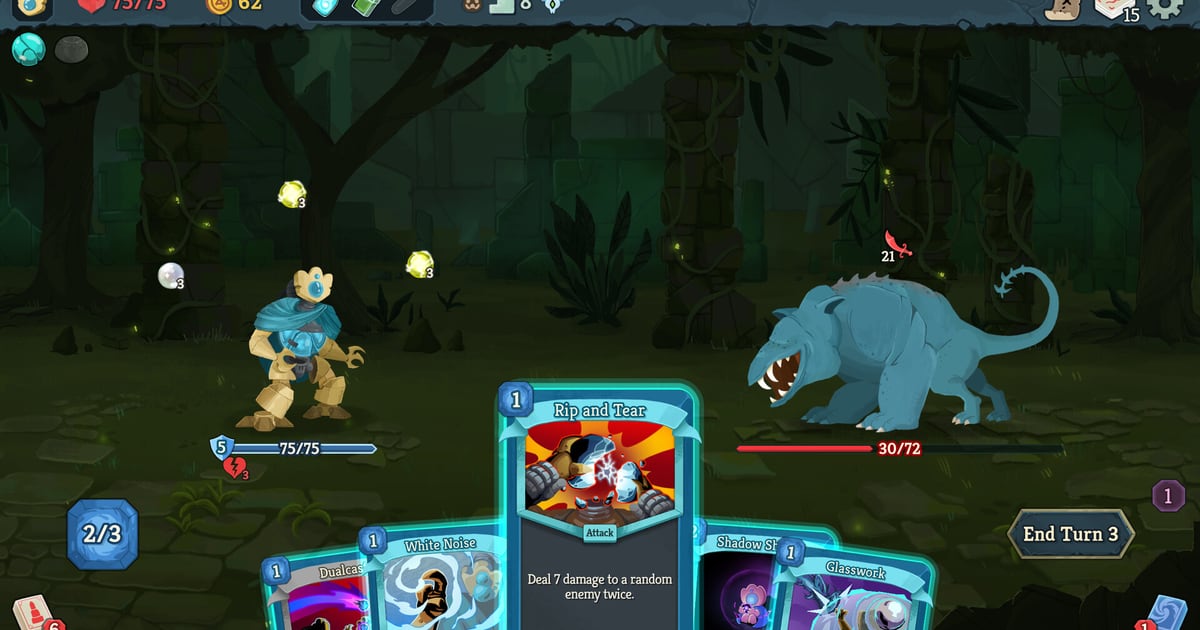
This site already has a piece on Slay the Spire 2’s co-op structure and its five-character roster — that guide covers who you can play and how a shared run splits its rewards. This one starts where that stops: the question is where the run’s gold, card slots and hit points should go. There is no tier list below; card rankings age badly and answer the wrong question. What follows is the deck’s economy — what the Spire pays out, what it charges to take a card back, and how the sequel’s act structure moved the moment when fighting an Elite stops being a gamble.
What this covers: the run-level maths of a Slay the Spire 2 deck — gold in and out, the card-removal price ladder, the hidden rare-card counter behind every reward screen, where the Elite window sits now that Act 1 is randomised and Ancients heal to full, and the four slots an archetype needs before it functions. Why it matters: the sequel’s difficulty is loaded onto deck efficiency rather than card power, and the Ascension ladder taxes removal and rare frequency directly instead of just inflating enemy HP. Who should care: anyone who has won a run and wants to win consistently, and anyone climbing the 10-level ladder who keeps losing to the same kind of deck.
The sequel is built around the deck, not the card
Mega Crit has been unusually explicit about this. Asked in the August 2026 Neowsletter why Enchantments do not stack, co-founder Casey Yano gave the design intent away in one line: “we explicitly disallow stacking of enchantments as the probability of snowballing with a single card goes up. We want our players to experience deckbuilding rather than cardbuilding!”
That is the thesis, in the developer’s own words. Enchantments — one per card, no stacking — are the sequel’s headline new verb, and the studio capped them so the win does not come from making one card enormous. It comes from what else is in the pile.
A run has three currencies: gold, card slots and hit points. Card slots are the strange one, because they cost nothing to acquire — which is why players over-acquire them. Every card you add makes each of your good cards less likely to be in the five you draw. That is the argument for removal, and the sequel prices it accordingly.
What a run actually pays you
The payout schedule is fixed, so a run’s budget is not a guess. Base figures, before Ascension modifiers:
| Source | Gold | Extras |
|---|---|---|
| Starting purse | 99 | — |
| Normal encounter | 10–20 | Choice of 3 cards, sometimes a potion |
| Elite encounter | 35–45 | A random relic, a choice of 3 cards at a higher rare rate |
| Treasure chest | 42–53 | One relic; guaranteed at the halfway point of Acts 1, 2 and 3 |
| Act 1 and Act 2 boss | 100 | A choice of 3 Rare cards, sometimes a potion |
| Act 3 boss | — | Run victory; unlocks the next Ascension level |
The largest single line item is not a fight — it is the two act bosses at 100 each, and that gold arrives after the moment you most want a relic. Encounters are also pooled: an easy and a hard pool per act, with the first three encounters of Act 1 and the first two of Acts 2 and 3 drawn from the easy pool, so the good fights are back-loaded.
The cheapest card in the deck is the one you cut
At The Merchant, the shop offers five character cards — always two Attacks, two Skills and one Power, one of them at 50% off — plus two Colorless cards, three relics, three potions, and a card removal service usable once per visit. What those cost:
| Purchase | Price (base) | Price at Ascension 6 |
|---|---|---|
| Card removal, first | 75 | 100 |
| Card removal, second | 100 | 150 |
| Card removal, third | 125 | 200 |
| Cards, Common / Uncommon / Rare | 48–53 / 71–79 / 143–158 | — (no Ascension modifies card prices) |
| Colorless cards | 15% above the coloured price | — |
A crossover falls out of that. Your first removal costs 75 gold, roughly an Uncommon card; your fourth costs 150, roughly a Rare. At Ascension 6 the ladder steepens — 100, 150, 200 — so by your second cut you are paying Rare-card money. Early cuts are the best value in the shop; past the third or fourth they are no longer obviously better than a good card or a relic.
What a cut buys is not damage. With five cards and three Energy a turn, every dead card converts a draw into a wasted one. Removing the fourth or fifth Basic Strike is the point at which a deck starts drawing its own engine twice a cycle instead of once.
The reward you skip is a free removal
The detail that reshapes reward screens most is the counter behind them: a reward’s rare chance is a base value plus an offset. The offset starts at −5%, rises by 1% for every non-rare card rolled, caps at 40%, and resets to −5% whenever a rare is generated. The base rare chances are:
| Reward source | Rare chance (base) | At Ascension 7 |
|---|---|---|
| Normal encounter | 3% | 1.49% |
| Elite encounter | 10% | 5% |
| Shop stock | 9% | 4.5% |
| Act 1 / Act 2 boss | 100% (always Rare) | — |
Three consequences follow:
- Skipped rewards advance the counter. The wiki states it plainly: card rewards that are skipped still affect this counter. Taking a card and skipping one are identical for future rare odds — so skipping is strictly better when the card is not one you want, because you keep the slot as well.
- Your first reward of each act can never be rare. The offset starts negative and a regular reward adjusts three times, so the first card reward of Act 1, Act 2 and Act 3 has no chance of a rare. It is the worst reward you will be offered all act, and therefore the cheapest to skip.
- Shop cards do not move the counter, but they are affected by it. A dry spell in combat rewards raises the shop’s rare odds too.
Ascension 7 halves both the base chance and the per-roll increment, which is why high-Ascension decks get built from Uncommons and upgrades. Reading a reward screen as “three slots and a counter tick” rather than “three cards, pick one” is the largest shift in how a run’s economy is spent.
Where the Elite window sits now
The existing guide covers what an Elite is. The structural question is when to fight one.
An Elite pays a relic, 35–45 gold, and three cards at a 10% base rare rate — more than triple the 3% of a normal fight. Relics are the run’s permanent power, and outside events and the shop the Elite is the only renewable source. Per act there are three Elite types; one can repeat, but not until all three have been seen, and never twice in a row. The window is a timing decision because of the recovery structure:
- Every act opens with an Ancient, and Ancients heal you to full — 100% of missing HP, 80% at Ascension 2. The floor after the Act 1 and Act 2 bosses is always an Ancient floor.
- A rest site is guaranteed before every boss, healing 30% of max HP or upgrading a card.
- Boss floors sit at 17, 33 and 48 in a solo run.
Put those together and the health maths inverts. Hit points spent on the last few floors of Act 1 or Act 2 are refunded wholesale at the next Ancient. Hit points spent in the first half are not — you carry them until a rest site, and a rest site is a turn you did not spend upgrading a card. So the Elite window is the back half of each act. An Elite at floor 15 costs a fraction of what the same fight costs at floor 5.
Two things move it. Act 1 is no longer a fixed zone: it resolves to Overgrowth or Underdocks, each with its own three Elites and three bosses. Mega Crit’s write-up of its June RNG rework spells the roll out — a decimal below 0.5 gives Overgrowth, above it gives Underdocks — so you cannot plan an Act 1 Elite route before the map exists. And Ascension 1 makes Elites roughly 60% more common: a difficulty increase, but also a relic supply increase, which is why A1 runs feel richer before they feel harder.
It will move again: the August 2026 roadmap listed an alternate Act 2 as in development, and the September Neowsletter confirmed work continues without a date. One warning about the end of the run — at Ascension 10 a second boss is fought at the end of Act 3, immediately after the first, with no rest between, so every Elite near floor 48 is paid out of that fight’s budget rather than the Ancient’s.
The four slots an archetype needs before it functions
Before a deck has a plan, it needs four jobs filled. Not four specific cards — four roles. A deck missing any one of them loses to the same failure every time.
| Slot | What it does | What its absence looks like | Typical source |
|---|---|---|---|
| Enabler | Produces the resource your payoff spends | You draw the payoff; nothing to spend | Character kit |
| Payoff | Converts that resource into damage or Block | Long fights you cannot close | Elites and bosses, mostly |
| Draw or selection | Makes enabler and payoff appear together | You own both, never in the same hand | Shops, Colorless cards, upgrades |
| Tempo | Energy, cost reduction, free plays | Right three cards, affordable two | Ancient and shop relics |
The reasoning comes from the fixed combat frame: five cards and three Energy a turn, so a deck plays at most three cards no matter how good its hand is. Enabler and Payoff with no Tempo, and you assemble a combo you cannot pay for. Payoff with no Draw, and you assemble it once every four turns. Draw and Tempo without Payoff, and you cycle smoothly into nothing.
The Enabler slot is where the sequel’s identity shows. In the 2019 game the resource was almost always Energy. Here it is character-shaped — Stars that persist between turns and are spent rather than refilled, Forge counts, orbs channelled and evoked, Exhaust payoffs, Poison that bypasses Block, Shivs that arrive as Token cards. Those are kit details, not purchases; the existing co-op and character guide covers them properly. What the ledger adds is that the Payoff slot is the expensive one — the rare you buy at 143–158 gold.
A fifth thing is not a card: the cut you make so the other four show up. Take only what fills those slots, remove the rest, and deck size stops being a number you track and becomes a number you choose.
What Ascension actually taxes
The sequel’s ladder stops at 10, not the original’s 20, and Yano explained why in the August Neowsletter: “Our general thought has been that Ascension 10 is close to the highest difficulty we’ll have for the game. Grinding out Ascension 20 would be quite a chore as there are more characters in the sequel.” What the ten levels tax is the useful part:
| Level | Modifier | Effect on the deck economy |
|---|---|---|
| 1 | Swarming Elites | ~60% more Elites — more relics, more 10%-rare rewards, more HP spent |
| 2 | Weary Traveler | Ancients heal 80% instead of 100% — the back-half Elite discount shrinks |
| 3 | Poverty | Enemies and chests drop 25% less gold — fewer cuts and fewer cards |
| 5 | Ascender’s Bane | A permanent unplayable Curse in the deck from floor one |
| 6 | Inflation | Removal starts at 100 and climbs by 50 — the cut ladder doubles in slope |
| 7 | Scarcity | Rare and Upgraded cards appear half as often |
| 8–9 | Tough / Deadly Enemies | More HP and more damage on everything, including Elites |
| 10 | Double Boss | Two bosses back to back, no rest between |
The pattern is not “enemies get bigger”. A3 and A6 attack the shop, A5 and A7 attack deck quality, A2 attacks the recovery window, A1 attacks it from the other side by more than doubling the Elite supply. An Ascension climb rewards players who already budget rather than players who already know the cards.
Which build this assumes
As of 29 October 2026 the newest published notes are the v0.111.0 beta patch of 14 August 2026, and nothing has appeared since. The last update on the default branch was Major Update #2, v0.107.1, on 19 June 2026; beta patches v0.108 to v0.111 sit on top of it. The September Neowsletter said the studio could not give “a specific timeline or details for the next patch”, so the gap is deliberate. Two of the sources here — the Enchantments and Cards pages — carry the wiki’s own beta-content warning, so treat anything enchantment-specific as beta-branch behaviour until a main-branch update lands.
One figure needs a caveat. The patch that promoted Ascension 6’s Inflation modifier to the main build also records the base removal price moving from 75 to 100 gold, and the wording does not make clear whether that is the Ascension value being merged or the base value changing. The figures here — 75 base, 100 at Ascension 6 — are consistent across both pages.
What is not in dispute is the direction. The sequel raised the price of taking a card back on the same update that made a difficulty tier out of it, capped how far enchantment can push a single card, and said in writing that it wants deckbuilding rather than cardbuilding. A guide that starts from card rankings is answering a question the developer stopped asking.