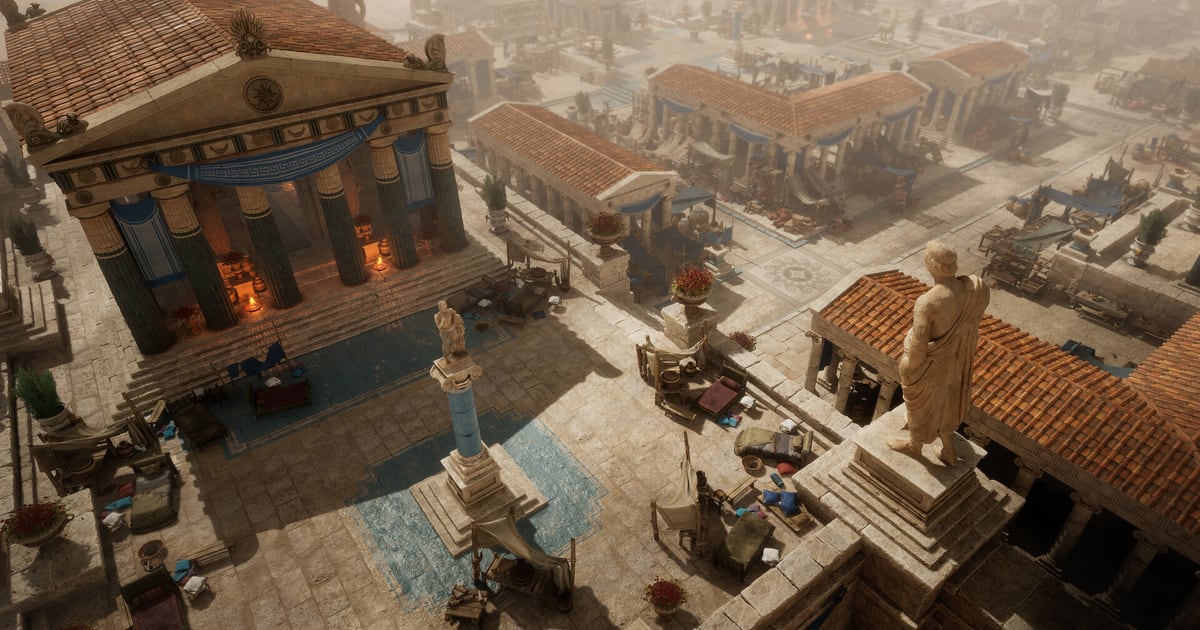
Nearly two decades after Brian Sullivan’s classic mythological ARPGARPG. Action RPG — an RPG with real-time combat rather than turn-based fights. debuted, Grimlore Games revives classical antiquity in Titan Quest II. Set in an Unreal EngineUnreal Engine. A widely-used commercial game engine from Epic Games; powers many large-studio (AAA) games. UE5 is the current generation. 5 recreation of ancient Greece, players must oppose Nemesis, the Goddess of Retribution, who has corrupted the Threads of Fate. Retaining the franchise’s iconic foundation, character progression is defined by selecting and combining two distinct Masteries, yielding hybrid hero classes with deep skill customization.
What this covers: The Dual-Mastery framework, Warfare, Earth, Storm, and Rogue masteries, Skill Modifier nodes, and Attribute scaling (Might, Agility, Vigor, Knowledge). Why it matters: Unlike static classes, combining two masteries generates specialized hybrid archetypes (e.g. Battlemage, Tempest, Revenant) with unique passives. Who should pick this: ARPG veterans seeking deliberate, high-fidelity mythological isometric combat.
The Dual-Mastery Class Combinations
You do not select a Mastery at character creation. Your first arrives during the early quest The Hunt Begins — available as soon as level 2, though you can delay the choice and remain “Unblessed” — and your second during The Queen of the Mountain, as early as level 8, creating a unique named class title:
| First Mastery | Second Mastery | Resulting Hero Class | Tactical Core Archetype |
|---|---|---|---|
| Warfare | Earth | Battlemage | Melee fire imbues, volcanic ground slams, heavy armor survivability |
| Storm | Warfare | Tempest | High-speed shock whirlwind, chain lightning weapon procs |
| Earth | Storm | Elementalist | Pure ranged spellcasting, dual elemental damage multipliers |
| Rogue | Warfare | Reaver | Bleed damage, poison coatings, critical strike backstabs |
| Rogue | Storm | Stormblade | Evasive lightning dash strikes, blinding smoke clouds |
| Rogue | Earth | Ashstalker | Fast single-target and multi-target bursts from an ailment-heavy kit |
Investing points down each mastery’s vertical tier meter unlocks higher skill tiers and boosts your base attributes — Dexterity, Intelligence, and Strength — amplifying damage output based on your chosen damage type.
Divinity Points and Mastery Progression
Masteries are not picked from a menu — they are unlocked in the world. Early in the campaign you meet Divine Altars (the wiki also calls them Shrines) built around large red crystals, and interacting with one grants access to the Divine Masteries you combine. From there, progression runs on two currencies:
- Mastery Points: earned on level-up and spent on the vertical tier meter to unlock and enhance skills. Lower-tier skills must be unlocked before the tree opens higher tiers, and higher-tier skills demand more points.
- Divinity Points: spent to raise the rank of each chosen mastery, which is what actually unlocks higher-tiered abilities. They arrive from progressing the story, completing objectives, defeating bosses, and leveling.
Every active skill can climb to Rank 20, and the higher the rank the more Modifier Nodes it can carry — up to five per skill. Passive skills instead open Feat slots at Level 3 and Level 6. Modifiers can be swapped onto and off a skill at any time, so a build is never locked into an early experiment. The masteries themselves, though, cannot be changed once selected: only the points inside them can be refunded, and that refund costs gold.
Signature Skills by Mastery
Beyond the two worked examples above, each tree carries a full active roster with its own modifier suite:
| Mastery | Signature Active Skills | Concrete Base Effect |
|---|---|---|
| Warfare | Heavy Attack, Barrage, Stomp, Doom Horn, Leap | Heavy Attack deals 180% Weapon Damage; Stomp deals 12 Strike Damage in a 3m radius and stuns for 0.4s; Doom Horn cuts enemy Damage Resistance by 12% for 4s |
| Earth | Rolling Magma, Earthquake, Flame Volley, Ignite, Ring of Flame | Earthquake hits for 26 Strike Damage in a 4m radius; Ignite burns a target for 8 Fire Damage every 0.5s over 4s |
| Storm | Call Lightning, Ice Nova, Blink, Cyclone, Storm Nimbus | Ice Nova deals 15 Cold Damage in a 4m radius with a 25% chance to Freeze for 1s; Cyclone ticks 4 Cold Damage across a 7m area for 10s |
| Rogue | Lethal Strike, Bladespin, Grenade, Flicker, Vanish | Lethal Strike deals 200% Weapon Damage to one target; Flicker dashes 8m for 13 Pierce Damage; Vanish grants 30% movement and damage for 6s |
| Forge | Armor Eruption, Blade Trap, Force Field, Sentry, Ironclad | Forge skills spend Divine Cores as a second cost; Sentry summons a turret that fires every 0.8s |
Modifiers scale the same skill in opposite directions — Sweeping Strike’s Whirlwind converts it into a 2.2m channeled spin while Deadly Reach instead pays a 20% damage bonus on the outer edge — so the node you equip, more than the skill you pick, is where a build takes shape. If you are coming from another ARPG, the Grim Dawn masteries and devotion build guide makes a useful comparison for how the two systems reward modifier stacking.
Skill Modifier Nodes: Customizing Spells
In Titan Quest II, skills are not static abilities. Each core active skill features surrounding Modifier Nodes that alter its physical behavior:
- Sweeping Strike (Warfare): The core skill sweeps a circle for 120% weapon damage in a 4m radius; adding the Whirlwind Modifier converts it into a channeled spin dealing 20% weapon damage in a tighter 2.2m radius, while Ramp Up grows its damage and radius the longer you channel.
- Fissure (Earth): Splits the ground in an 8m line that slows enemies by 20%; the Lava Fissure Modifier fills the crack with lava for lingering fire damage, and Additional Fissures spawns an extra fissure in a cone.
Attribute Scaling and Gear Requirements
Equipping high-tier mythological weapons (such as Bronze Spartan cuirasses or Minoan daggers) demands meeting strict attribute requirements:
- Might: Governs heavy armor rating and physical blunt/slashing damage.
- Agility: Dictates attack speed, movement speed, and weapon critical strike chance.
- Knowledge: Amplifies elemental spell damage, cooldown recovery, and maximum Energy reservoirs.
- Vigor: Scales maximum Health, health regeneration, and physical stun resistance.
Balance your dual-mastery attribute investments to ensure you meet armor requirements without starving your primary damage stats.
How Main and Secondary Attributes Interlock
Titan Quest II folds the predecessor’s Strength/Dexterity/Intelligence trio into four Main Attributes, each of which feeds two or three Secondary Attributes that carry the actual damage scaling. You cannot spend points on a secondary attribute directly; you raise it by raising its parents.
| Main Attribute | Measures | Feeds | Gear it empowers |
|---|---|---|---|
| Might | Power and aggression | Fitness + Resolve | Heavy Armor, Ornate Armor, heavy weapons (axes, maces, mauls) |
| Agility | Speed and finesse | Cunning + Fitness | Light Armor, Medium Armor, fast weapons (swords, daggers) |
| Knowledge | Expertise and insight | Cunning + Resolve | Magos Robes, Plated Robes, magical weapons (staves) |
| Vigor | Health and tenacity | All three secondaries | Raises base Health Points |
| Secondary Attribute | Damage Type | Derives From |
|---|---|---|
| Cunning | Poison and Lightning | Agility + Knowledge |
| Fitness | Strike and Pierce | Agility + Might |
| Resolve | Fire and Cold | Might + Knowledge |
The payoff is hybrid math. A Battlemage that stacks Might powers Fitness for its physical Sweeping Strike and Resolve for its Earth fire damage at the same time, so one attribute funds both halves of the class. Vigor is the universal glue: because it nudges all three secondaries and raises base Health, it keeps an off-mastery’s skills relevant without forcing a split into a third attribute.
Attribute Points, Quest Rewards, and Respecs
You receive 2 Attribute Points per level, and the recommended rhythm for a focused build is roughly a 2:1 split — two points into the primary damage attribute, one into Vigor. Because high-tier gear carries hard attribute requirements, veterans bank a few unspent points so a dropped weapon can be equipped on the spot instead of waiting a level. World quests also hand out single Attribute Points; the confirmed ones include Defend the Enclave, Headhunt, The Shattered God, and The Tricksters Shrine. If the spread goes wrong, the Ritual Shrine in Pyrgos (the God’s Altar) refunds every attribute point.
Forge and Spirit: The Expanding Mastery Roster
The four launch masteries are no longer the whole grid. The current Early Access index also lists Forge — “Craft Divine Wonders,” with the Devastator, Saboteur, Stormwright, and Bastion combination classes — and a Spirit tree whose combinations are Revenant, Frosthand, Awakener, Tombwarden, and Phantom. Forge is the first tree built around a second resource, spending Divine Cores alongside Energy on skills such as Blade Trap, Chains, and Sentry, which makes Divine Core generation a core build question rather than an afterthought.
Grimlore is not finished, either: the studio’s Early Access plan adds masteries on roughly a three-month update cadence, and the launch roster covered only a fraction of the eleven masteries the 2006 original eventually fielded. For anyone planning a long-term character, that cadence is the argument for leaving a little slack in the attribute spread.