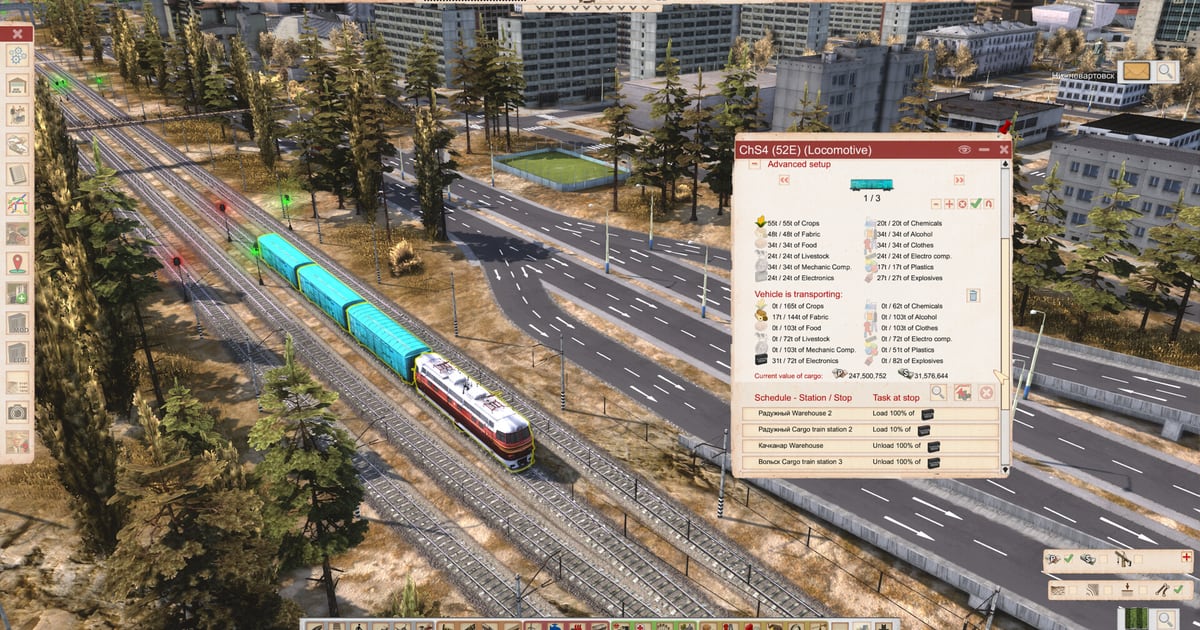
Workers & Resources: Soviet Republic is widely regarded as the most demanding logistical city-builder ever created. Operating under realistic simulation settings, nothing spawns from thin air: steel, gravel, concrete, fuel, and citizens must be physically loaded, transported, and delivered. The lifeblood of your planned economy during the first decade is the Customs House along the Soviet border, and managing high-capacity rail transit to and from this border point dictates economic survival.
What this covers: Customs House throughput bottlenecks, Semaphores and Chain Signals, Rail Distribution Offices, and dedicated aggregate storage buffers. Why it matters: A single train deadlocked on a border crossing blocks all grain, fuel, and coal imports, causing your entire republic to freeze to death in mid-winter. Who should pick this: Planners attempting to industrialize their socialist republic without stalling rail logistics.
The Customs House Bottleneck
Border Customs Houses have strictly limited track and road connections (typically 1 to 2 rail lines and 2 to 4 road lanes). If three freight trains attempt to enter the border station simultaneously, they will wait on the mainline, blocking all traffic behind them:
| Infrastructure Asset | Cargo Capability | Turnaround Speed | Deadlock Risk Factor |
|---|---|---|---|
| Border Customs House | Direct export / import of all goods | Slow (meters fill sequentially) | Extreme if trains wait inside intersection blocks |
| Rail Distribution Office (RDO) | Automatically schedules train runs | High (dispatches on % thresholds) | Low when tied to external rail loops |
| Aggregate Storage (Gravel/Coal) | 1,000+ tons loose materials | Instant conveyor throughput | Minimal (buffers border train delays) |
| Liquid Cargo Hub (Fuel/Oil) | Piped liquid hydrocarbons | High-flow pumping stations | Medium (requires dedicated rail tankers) |
Rail Signaling Law: Block Signals vs Chain Signals
Rail signaling in Soviet Republic follows strict mathematical railway logic. Violating signal placement creates unresolvable head-to-head train standoffs:
- Chain Signal (Two Lines on Post): Always place before an intersection or junction. A Chain Signal reads the state of the subsequent signal down the line. If the destination block is occupied, the train is held before entering the junction, leaving the crossing clear for perpendicular traffic.
- Block Signal (Single Line on Post): Place after the intersection. Signifies entry into a safe, independent rail segment where a train can wait without blocking other switch tracks.
- The Golden Rule: Chain IN, Block OUT. Never place a standard Block Signal immediately before a junction.
The Rail Distribution Office (RDO) Workflow
Never assign static, permanent train routes directly between your domestic steel mills and the border. If your steel mill’s storage is full, the train will sit idle on the tracks, wasting diesel and occupying track capacity.
- Construct a Rail Distribution Office.
- Assign locomotives and freight wagons to the RDO depot.
- Set programmatic thresholds: “Dispatch train to Border for Coal only when Power Plant storage drops below 30%; dispatch train with Steel for export only when Steel Mill storage exceeds 70%.” This ensures locomotives only run when full cargo loads are ready, maximizing track utilization.